
This post considers the myth of Philomela, John Keats’ famous “Ode to a Nightingale,” and the concept of the Jungian Shadow — all in relation to Finnegans Wake. The post ends with an extended reflection on the importance of recognizing and owning the darkness within us, and the value of literature, especially the Wake, in helping us do this.
It surprises me that the annotations of the Wake list no direct references to “Ode to a Nightingale,” which is probably Keats’ most well-known poem. The ode is a phenomenal piece of poetry, and quite fitting to read side-by-side with Finnegans Wake. At the end of the bird’s song, the speaker wonders,
Was it a vision, or a waking dream?
Fled is that music:—Do I wake or sleep?
In the liminal space between waking and slumber, the speaker addresses the nightingale as “not born for death, immortal Bird!” Its song has echoed through the ages, linking the present to the past (and even to myth, like the story of Ruth in the Bible):
The voice I hear this passing night was heard
In ancient days by emperor and clown:
Perhaps the self-same song that found a path
Through the sad heart of Ruth, when, sick for home,
She stood in tears amid the alien corn;
The same that oft-times hath
Charm’d magic casements, opening on the foam
Of perilous seas, in faery lands forlorn.
This sounds a bit like Finnegans Wake itself, in which storytelling can connect us to the origin of all stories, which is represented in the Wake by the encounter of HCE (Here Comes Everybody, all of us) with his double:
all […] could simply imagine themselves in their bosom’s inmost core, as pro tem locums, timesported acorss the yawning (abyss), as once they were seasiders, listening to the cockshyshooter’s evensong evocation of the doomed but always ventriloquent Agitator
All people, their “auriculars” able to “recepticle particulars,” can be transported across time and the yawning abyss, inhabiting the position of the Three Soldiers, hearing a deathless “evensong” that has sung across all ages. Here it manifests as gossip and storytelling about HCE, and it also appears as all of literature and all storytelling, including the stories we tell ourselves about our lives all the time. It is the inner conflict of each of us that spills out into external struggles.
But where the speaker of Keats’ poem longs to “Fade far away, dissolve, and quite forget / What thou [the nightingale] among the leaves hast never known,” i.e. old age and death, the characters of Finnegans Wake have no escape from death, which is intermixed with the raucous brawls of life and its torments of love and jealousy. Underlying all experience is the decline and the death bed that inevitably awaits us. The death bed is, in fact, here right now, in this Moment, along with every Fall and Rise in all history and myth and literature and legend, all of it summed up and symbolized in HCE.
Keats’ poem suspends us, like its speaker, in negative capability, the power to abide in uncertainty without “irritable reaching after fact and reason.” The Wake, too, puts us in arguably more radical uncertainty, but it treats us to a song that is not an escape from the cycles of death and rebirth and desire, as Keats’s speaker longs for, but an embrace of those cycles, an embrace of a selfless riverrun that can unself us if we let it, help us understand the self as a series of stories.
I discuss that idea in this post, among other places:
the same cycle [of generations, of desire and dissatisfaction] that is unsatisfying when seen from one perspective can be infinitely satisfying if we accept that everything in it is impermanent; if we accept that there are no eternal things, or stable “things” at all; if we stop insisting that things in it “have to” be a certain way for us to be happy ; if we stop insisting that certain things “shouldn’t be” (since every part of reality depends on the rest of it); if we start embracing the nature of things as change, without grasping onto part of it and trying to insist that it never change or go.
Why no references to “Ode to a Nightingale” in the Wake? Is this the ol’ anxiety of influence, in which writers deny, minimize (or misinterpret) their greatest sources of inspiration so as to rebel against them in an Oedipal fashion? Or is it simply that Joyce couldn’t possibly reference everything in his book?
*
The myth of Philomela explains the origins of the nightingale, a bird traditionally associated with poetry because of its beautiful song that it often expresses while hidden (Shelley writes, ” A poet is a nightingale, who sits in darkness and sings to cheer its own solitude with sweet sounds”). With the context of the myth, we can hear the sorrow in that song.
The myth is perhaps best known from Ovid’s Metamorphosis, where the details are pretty grisly: Philomela is raped by her sister’s husband, Tereus, who then cuts out her tongue to conceal his crime (he does this because Philomela refuses to be silent, and she tells him defiantly that she will let the world know what he’s done). She communicates to her sister Procne by weaving a tapestry of the crime, and then the sisters together get revenge by murdering Tereus’ son, boiling his meat, and and serving him as food to the father. Tereus then chases them with the intent to kill them, and the gods transform all of these characters into birds.
Now as a nightingale, Philomela is able to sing of her sorrow, and fulfill the promise she made to Tereus to make his crime widely known. It’s worth considering what she had said to him immediately after the rape, when he’s trapped her in an isolated cabin:
Still my revenge shall take its proper time,
And suit the baseness of your hellish crime.
My self, abandon’d, and devoid of shame,
Thro’ the wide world your actions will proclaim;
Or tho’ I’m prison’d in this lonely den,
Obscur’d, and bury’d from the sight of men,
My mournful voice the pitying rocks shall move,
And my complainings echo thro’ the grove.
Hear me, o Heav’n! and, if a God be there,
Let him regard me, and accept my pray’r
Through the nightingale’s song, Philomela’s pain echoes through the ages, and in a parallel way, artists all express their own sorrows and traumas through art — while themselves remaining hidden a la death of the author.
If we map this hideous myth onto Finnegans Wake , then we come to the uncomfortable conclusion that Tereus embodies HCE, and we are reminded that there is an unsavory and even evil side to HCE, as he is all villains and murderers and rapists throughout history as well as all good men and heroes. The dreamer of Finnegans Wake contains the potential for that sort of evil, as we all do in our unconscious minds at least.
I discussed in a previous post the primary reference to Philomela in the Wake. The line is ” Since our Brother Johnathan Signed the Pledge or the Meditations of Two Young Spinsters.” These figures are attributed in the margins to Diogenes, Philomela, Procne, and they are also versions of HCE with the two Girls in the Park. HCE is both risen (having “signed the pledge,” or given up drinking) and fallen (knocked out in a speakeasy, as it says in the footnote attached to this line). He resembles Jonathan Swift with his two Esthers (see here and here), and also Diogenes (whose name, like “Jonathan” translates to a version of “given by God”). Diogenes, we should note, was an ancient Greek philosopher who radically challenged social norms by doing things like masturbating and urinating in public, making him a particularly apt figure to compare with HCE.
We are thus reminded that HCE’s offense in the Park has a quite sinister aspect. Like Leopold Bloom masturbating in public in Ulysses, HCE is kind of a creep to say the least. At best, he’s someone who merely desires to be a peeping tom, or fantasizes about it. If he does act on these desires, the best case scenario is that the girls are willingly teasing him and are fully consenting to whatever it is he does. This is basically the scenario we’re presented with in Ulysses, where Gerty MacDowell seems aware that Bloom is masturbating and is excited and actively encourages him by revealing her underwear. Of course, there we have to wonder how much of that chapter is an unmediated look into Gerty’s perspective and how much is Bloom’s speculation about her perspective. And even if Gerty is in fact completely and enthusiastically consenting, it’s still a creepy thing for Bloom to do this in public, and it’s distasteful and disturbing, to put it mildly, that he started playing with himself before he knew for sure she’d be into it. I guess he got lucky that she liked it, or he’s an amazing reader of body language.
But as I said in that earlier post, even though Joyce “doesn’t want us to revile” Bloom and HCE, “he’s also not celebrating their behavior in their most ignoble moments.” We’re not supposed to read this chapter of Ulysses and be impressed with how great Bloom is. We’re certainly not supposed to admire him for this or want to emulate him here. We’re supposed to reflect on how pathetic he is, how little self control he has, and what being cuckolded has reduced him to (or, rather, what he’s allowed it to reduce him to).
It’s an honest and unflinching look at a serious flaw, at someone acting on lustful impulses that most of us successfully resist or repress. But those impulses are there in the human psyche, and some people do act on them. And this is the stuff of art and literature: people’s unsavory desires, people’s transgressions against others, and themselves, the disastrous consequences that follow from them, and the way that people endure them. These often uncomfortable facts run through nearly all of literature and myth and history, which concern humanity (Here Comes Everybody) in conflict with its own base impulses (the Cad), running up against its tendency to idealize and moralize (Shaun) and feel shame and guilt and to transmute all of those feelings into art (Shem).
And so HCE and his crime in Finngeans Wake is an archetype of a man realizing that he has base desires within himself. Or it’s a man acting on some version of those base desires. At its most mild, he engages in some harmless fantasy about some things that would be harmful if he acted on them, or he engages in consensual sex play. At its most severe, he violates other people and scars them.
Finnegans Wake seems to suggest that all of us are on that spectrum somewhere, finding these dark things in us, or denying that they’re there and becoming moralizers, or acting on them to some degree and then facing the consequences.
As I write about this, it’s reminding me of Jung’s idea that all people contain a “shadow,” the archetype that consists of all the qualities that we repress, the things we would rather not face about ourselves. We often project that shadow onto others, seeing our own deepest and denied flaws in other people’s actions. Part of the idea of becoming a psychologically healthy person, in Jung’s view, involves bringing those elements into conscious awareness and integrating them into the whole person. This is very similar to Freud’s ideas about bringing unconscious, repressed material to the surface. The main difference is that Jung stressed how the “shadow” could appear as an archetypal figure in mythology, creative works, and dreams. Many Jungians today believe one could use creative engagement with such figures as part of what they sometimes call “shadow work.” For example, gods of the underworld — most notably Satan in the Judeo-Christian context — are traditionally “shadow” archetypes. I could imagine a Jungian studying depictions of these figures, writing about them, creating art about them, and doing other things to identify with them — perhaps even “invoking” them in prayer — to locate and bring into the conscious self an awareness of the “shadow” aspects of the self. In this sense, a sort of (figurative) “devil worship” is psychologically positive.
Generally, most forms of so-called “Satanism” are silly adolescent expressions of poorly thought-through rebellion, but there is most definitely an intelligent way to “summon the Devil,” if you will. I’m reminded of Shem’s form “Glugg” in II.1: we are told “the duvlin sulph was in Glugger,” the Devil himself was in him. He “halth kelchy chosen a clayblade and makes prayses to his three of clubs.” He’s praying to the shamrock, it sounds like, that symbol of the true Trinity rather than the supernatural one of exoteric Church doctrine. “Djowl, uphere!” he prays. Devil, appear! Perhaps one could read II.1 as the gradual maturing of Shem’s Satanism.
The theory underlying “shadow work” is basically that if we deny our capacity for cruelty and evil, it’s going to come out in bizarre ways. So rather than deny it, we should recognize it, own it, accept it, and engage with it in fantasy and art rather than actual acts that will hurt others and ultimately ourselves.
From a Jungian perspective, what this boils down to is that all of the evil figures in stories and myths are actually parts of us reflected in fiction. So it can be therapeutic, in an oddball kind of way, for us to identify to some degree with the perspective of those figures, and — in a sense — “worship the Devil.” Now this doesn’t mean you have to break out the robes and the pentagrams (though for some people who had repressive religious upbringings, there probably is a psychological benefit to “larping” as a Satanic priest and acting out “prayers to the devil”). You can consume fiction that puts you into the perspective of both abusers and abused, of violaters and victims. You can stretch out your imagination to encompass the vastness of human experience, of Here Comes Everybody.
Percy Shelley says that the imagination is the moral muscle, allowing us to identify with others, but like every other muscle, it has to be exercised. Reading literature is a primary exercise. And I would add to this by saying the imagination can do more than just let us identify with others: it can help us identify with the parts of ourselves that hurt others and have been hurt by others, all the darkness and terribleness that we are desperate to repress and keep locked away.
And so back we come to Philomela and her horrid story. Everything about her tale is a nightmare. She suffers physically and psychologically. She makes her abuser suffer. She makes an innocent bystander suffer when she murders the son. She shares her sorrow with her sister. And she sings about it forever, producing a song that runs through all of time and links together the past and present and future. Tereus, her abuser, does insanely cruel things to her and suffers the horror of eating his own son. The son just gets murdered and put into a pie. Wrong place, wrong time.
Rather than look away from nightmares like that — nightmares that reflect what is in the heart of us all, the impulses that are acted upon to some degree again and again in real life — we do ourselves a favor to face these stories and find ourselves in them. We listen to the song of sorrow, open ourselves to it, so that it connects us not only to all humans throughout time but to our own capacity to suffer and make others suffer. Rather than repress and deny, we open ourselves to darkness, the kind of darkness that becomes more available to us in the dreamscape of the Wake.
Owning that darkness is a significant part of cultivating the light.
Anyway, file this post under a “heavy metal reading of Finnegans Wake.”
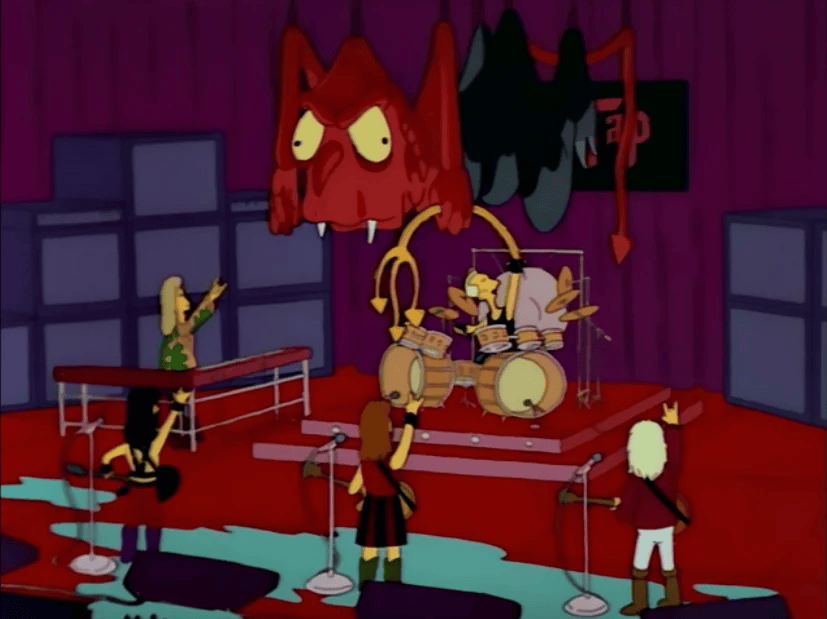
“We salute you, our half-inflated dark lord!”

