
This post looks at a phrase in that long quote I discussed in my last post, paying attention to a description of the “funferal,” one that seems to apply to Finnegans Wake itself. From there, I consider references to whales in Finnegans Wake.
Here’s a section of the passage that I discussed, part of the long paragraph surveying different textual features of ALP’s Letter:
look at this prepronominal funferal, engraved and retouched and edgewiped and puddenpadded, very like a whale’s egg farced with pemmican, as were it sentenced to be nuzzled over a full trillion times for ever and a night till his noddle sink or swim by that ideal reader suffering from an ideal insomnia
As I noted, “funferal” is a garbling of “funeral.” And just as there’s lots of fun at Finnegan’s wake — or so claims the song, at least — this funeral will be fun for all. Presumably, this “funferal” that we’re told to “look at” is some kind of textual detail in the Letter, some mark or illustration. But the way the narrator describes it makes it sound like he’s talking about the novel Finnegans Wake. I have often been fond of quoting these words to sum up the Wake‘s relationship with its readers. Many of us have indeed been sentenced — like HCE — by the sentences in this book to nuzzle and puzzle over its words with our noodles/minds, sinking or swimming through its waters (I’m reminded that Carl Jung reportedly said that Joyce’s mentally ill daughter, Lucia, whom he treated, was drowning in the waters of the unconscious while James was swimming in them).
The implication that an ideal reader of this text would have insomnia is interesting — that is, an ideal reader would be resistant to being absorbed into the dream of the text and instead stand “outside it” to some degree, gaining critical distance on it to ascribe meaning(s) to its sentences instead of being lost in them.
The comment “very like a whale” is a reference to a relatively obscure line in Hamlet (a “deep cut,” one might say), where Polonius agrees with Hamlet that a cloud looks “Very like a whale,” even though Hamlet has just gotten him to agree it looks like a camel and then that it looks like a weasel. Hamlet’s making fun of him, throwing out contradictory interpretations and just letting him agree with all of them. But isn’t that sort of what interpreters of the Wake do? We all toss out wildly different interpretations, and then we all nod at each other, our noodles sinking and swimming. Curiously, I had always interpreted “noodle” as meaning only head or mind, as in “use your noddle” to think. Do you believe that it took all these years for a dirty alternate interpretation to dawn on me? Nod your noodle if you agree.
Joyce has of course transformed this funferal into a whale egg, connecting it to the cosmic Humpty Dumpty from which Finnegan/HCE/the dreamer/the universe/all of us come from. The egg is the equivalent of the number zero, as I wrote about here and here. The fact that whales don’t lay eggs — and are, in fact, famously “mammals like you and me,” as The Simpsons reminds us in that cute clip — shows us the dream logic at work.
Stephen Dedalus invokes the line “Very like a whale” in Ulysses Chapter 3, thinking about his youthful plan to write books with letters for titles:
Someone was to read them there after a few thousand years, a mahamanvantara. Pico della Mirandola like. Ay, very like a whale.
I guess the idea here is that his readers would gullible buffoons like Polonius?
In that same chapter, as he walks on the beach, Stephen thinks of his ancestors cutting apart whales there with “flayers’ knives”:
Galleys of the Lochlanns ran here to beach, in quest of prey, their bloodbeaked prows riding low on a molten pewter surf. Dane vikings, torcs of tomahawks aglitter on their breasts when Malachi wore the collar of gold. A school of turlehide whales stranded in hot noon, spouting, hobbling in the shallows. Then from the starving cagework city a horde of jerkined dwarfs, my people, with flayers’ knives, running, scaling, hacking in green blubbery whalemeat. Famine, plague and slaughters. Their blood is in me, their lusts my waves. I moved among them on the frozen Liffey, that I, a changeling, among the spluttering resin fires. I spoke to no-one: none to me.
It reminds me of a passage in Finnegans Wake I.1, in which the Four Old Men survey the past by flipping through a history book, the “leaves of the living in the boke of the deeds”:
1132 A.D. Men like to ants or emmets wondern upon a groot hwide Whallfisk which lay in a Runnel. Blubby wares upat Ublanium.
“Walfisch” is German for whale. This whale is both wide and white, much like the Willingdone and his “big wide harse.” The whale is HCE, whom the little inhabitants of his dream — all the little Finnegans, waking into semi-independent existence from his unconscious mind — are carving up and devouring. As ever in the Wake, the fallen father sustains the universe, becoming the crops and the eucharist meal. (after all, “on the bunk of our breadwinning lies the cropse of our seedfather”).
There are many other references to whales in the book, most of which make HCE into this sort of blubbery creature, such as a footnote describing him as “fraywhaling round Myriom square” or Kersse calling him a “wutan whaal.” Of course, since HCE is also the Cad, he assumes the guise of a whaler too:
How did he bank it up, swank it up, the whaler in the punt
Curiously, there are no puns on Captain Ahab, at least not that I can find or recall.
The phrase “Very like a whale” shows up one more time in the Wake. Near the end of II.2, right before the ten monosyllables and “nightletter,” there is a long catalogue of figures throughout legend and history. The figures are named in the Shemish remarks in the left margin, described in the main text, and commented upon in the Issy-ish footnotes.
It’s difficult to match all of the figures to their description in the text. The description in question here is “Since our Brother Johnathan Signed the Pledge or the Meditations of Two Young Spinsters,” a line that references Jonathan Swift, the two Esthers with whom Swift was associated romantically, and the “pledge” to give up drinking (all mixed with the Wake‘s ur-myth of HCE tempted by two Girls in the Park). The footnote comment reads, “Wherry like the whaled prophet in a spookeerie.” It combines “very like a whale” with “Weary like a whaled [punched] prophet in a speakeasy.” Jonah, of course, was the whaled prophet, confined to the belly of a whale like HCE to his coffin. If the “Johnathan” here represents HCE, then he is both risen (having “taken the pledge”) and fallen (knocked out in a speakeasy). As we stand poised to enter “Spooky Season” in 2026, let me add that all this rising from the dead is spooky and eerie, involving spirits (ghosts and alcoholic drinks). Here is the whole “funferal,” once again implicitly compared to a “whale’s egg.”
Which legendary and/or historical figure in the Shemish margin does all of this correspond to? It seems to me it’s “DIogenes. Procne, Philomela.” The annotations point out that the name “Diogenes” means “born of Zeus,” while “Jonathan” comes from the Hebrew “God has given.” If the “Two Young Spinsters” correspond to Procne and Philomela, then we are prompted to reflect on that myth, in which a victimized girl has her tongue cut out before she is transformed into a nightingale, a symbol of poetry. I may perhaps reflect more on Philomela in a future post, especially since whales too sing a song….
One more: a paragraph in I.1 ends with the appearance of a whale. Most of the paragraph had been saying, basically, that the story of the Wake, and the torments of love and jealousy, has been and has gone and continues (“still nowanights and by nights”).
For that saying is as old as the howitts. Lave a whale a while in a whillbarrow (isn’t it the truath I’m tallin ye?) to have fins and flippers that shimmy and shake. Tim Timmycan timped hir, tampting Tam. Fleppety! Flippety! Fleapow!
This is a reference to the song “Finnegan’s Wake,” whose lyrics ask dancers to shake their trotters while informing us there’s “Lots of fun at Finnegan’s Wake!” Here, the shaking is the flapping of a whale in a wheelbarrow — which may be HCE locked into his coffin as a result of his deeds or his will (“whillbarrow”; compare to the “wholeborrow” earlier in I.1). Lave him there — leave him, wash him (in the flood/Fall), and make him or do him (“lave” is Danish for make or do). Or perhaps it implies the Fallen Father is the basis for all of our doings in the fallen world. It’s the whole story of Finnegans Wake compressed into the flapping flippers of that flayed, fallen whale. The sounds at the end are his flapping, and possibly the sounds of the misdeed(s) that resulted in the Fall.
Those sounds at the end of the paragraph remind me too of “Bibbity, Bobbity, Boo” from Cinderella, but this could not have been intentional on Joyce’s part, since the film Cinderella and that song came years after he died. Still, there’s no reason the words, and the in-jokes with which I associate it, cannot have personal meanings for me. Among other references that have meaning mostly to me is a moment from Tony Soprano’s dream in the Season Two finale episode “Funhouse” where he alludes to a fish “flopping.” There, as his dream avatar stands in front of a fish stand, his unconscious mind reveals to him that his dear friend is an informant for the FBI. This is a fairly well-known scene in which the informant appears as a talking fish to explain the revelation to Tony directly. Knowing he will have to murder this friend, Tony angrily overturns the stand and yells, “I want to see you flopping around down there!” as the dream ends. It’s actually unclear to me whether he says “I want” or “Don’t want” — both fit, and an indeterminacy between the two would be significant. Anyway, the relevance to Finnegans Wake and the “Fall” of the great fish HCE is obvious, unintended by Joyce, but personally meaningful for me.
It’s worth considering other comparisons in the Wake of HCE to a fish (see here and here), especially the Salmon of Knowledge caught by Finn MacCool in Irish myth (and a Sockdaloger).
One more personal note: whales have been a symbol of great importance for myself and the editor of this blog, quite aside from their role in the Wake. Although these creatures primarily signify HCE in the novel, I keep in mind an item from popular culture that links them also to the female principle of the universe — the wedding cake Homer Simpson was able to afford:
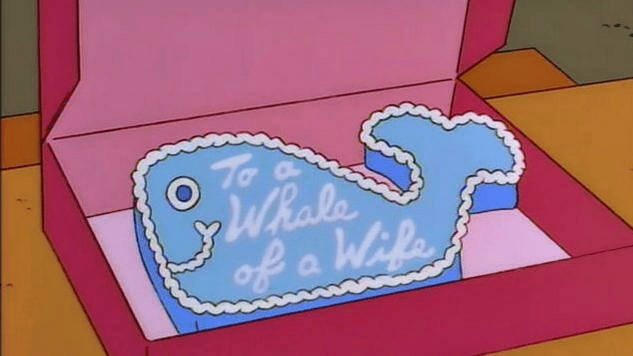
Whales attract mates by singing. The early emails to my editor that became the basis of this blog — and this whole blog from which they sprung — can be considered my whale song.
There’s lots of fun at Finnegan’s whale?

