
This post will discuss Thomas McNally’s illustrated edition of The Mookse & the Gripes, which adapts a set piece in Joyce’s Finnegans Wake. But mostly the post will be a self-indulgent reflection on my own relationship to this text, complete with pictures of puppets I made of these characters with my daughter about six years ago. Like McNally, we too were inspired to create new works of art. And, since I’m me, the post descends into an anti-AI rant. Enjoy!
McNally’s 2014 edition contains the entirety of Joyce’s “The Mookse and the Gripes,” which appears in Finnegans Wake I.6, and which I have written about here and here and here. He supplements Joyce’s words with over one hundred full-color illustrations. The result is a beautiful volume that I love looking at:
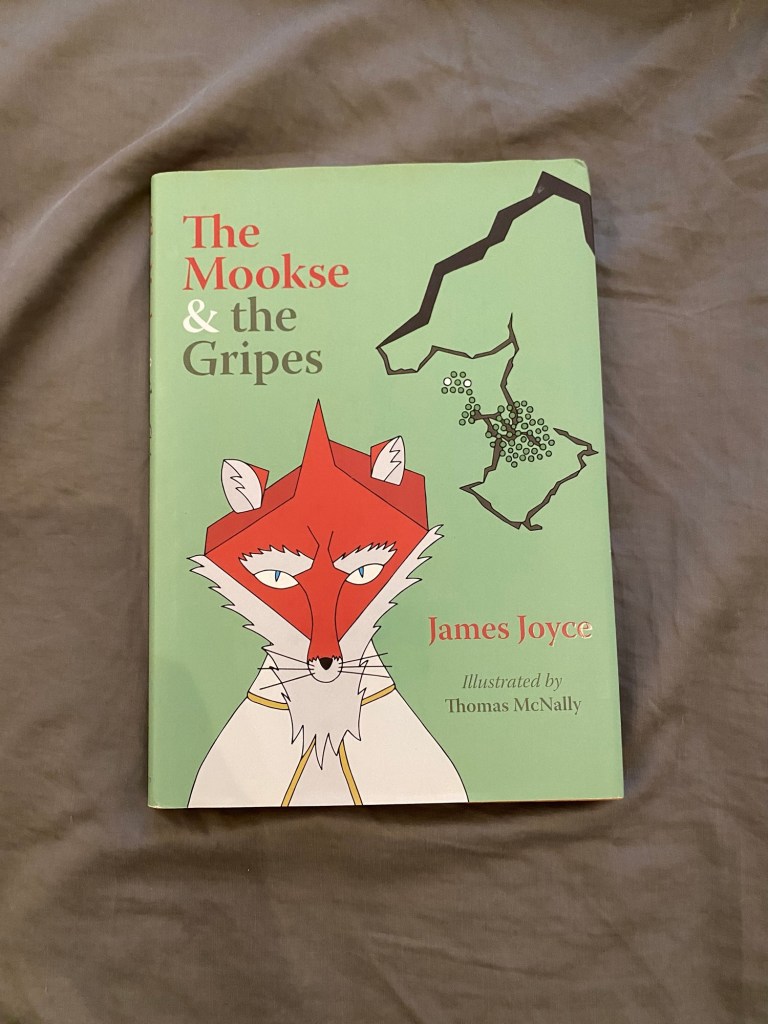
Here’s the opening:
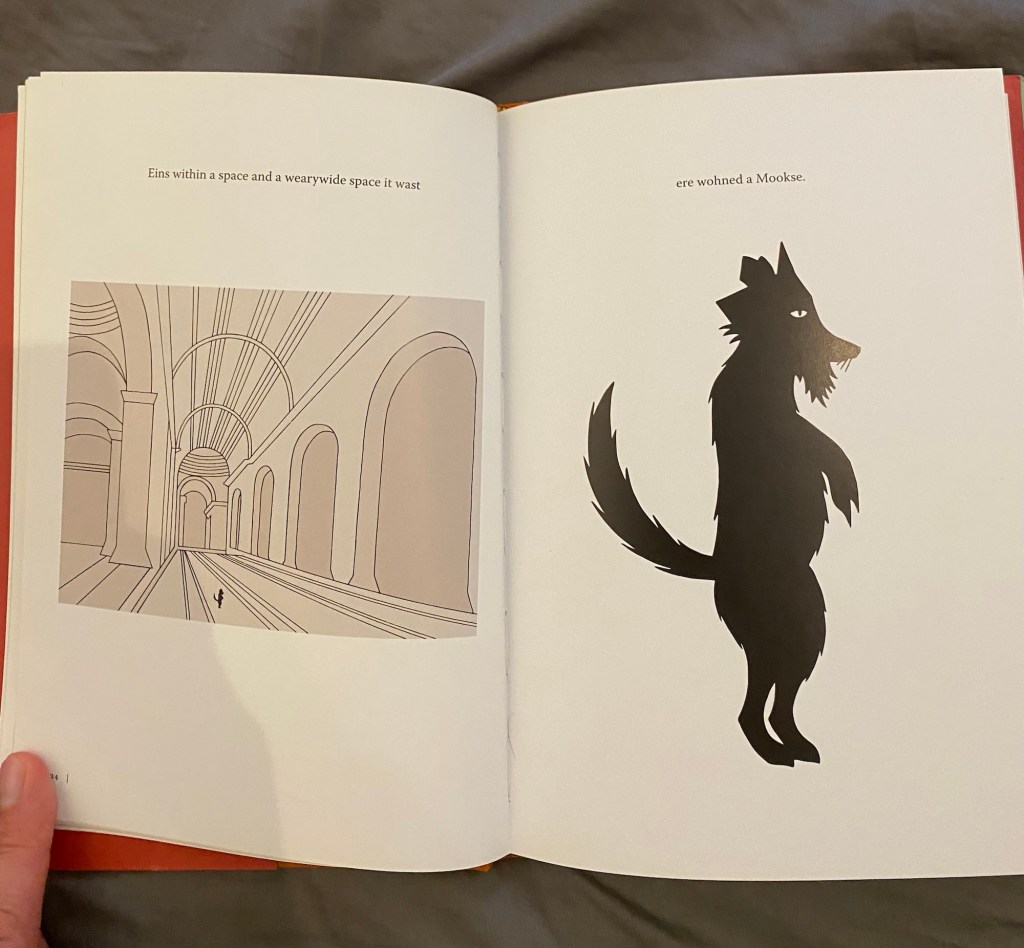
The Gripes:
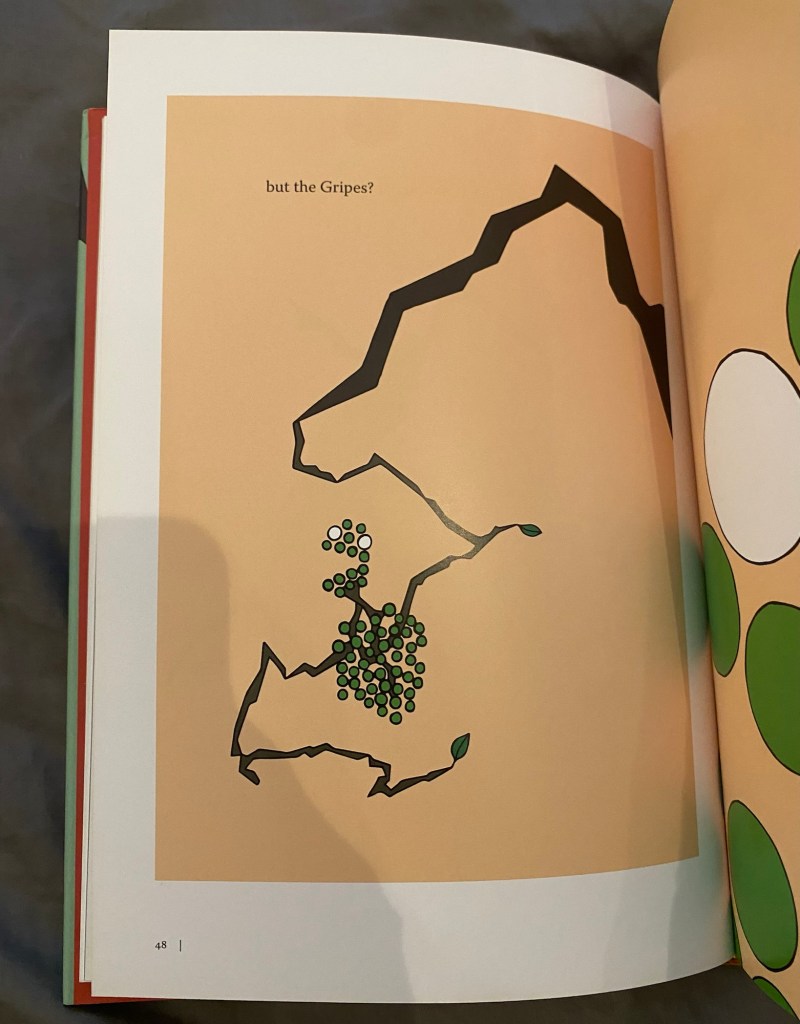
Nuvoletta:
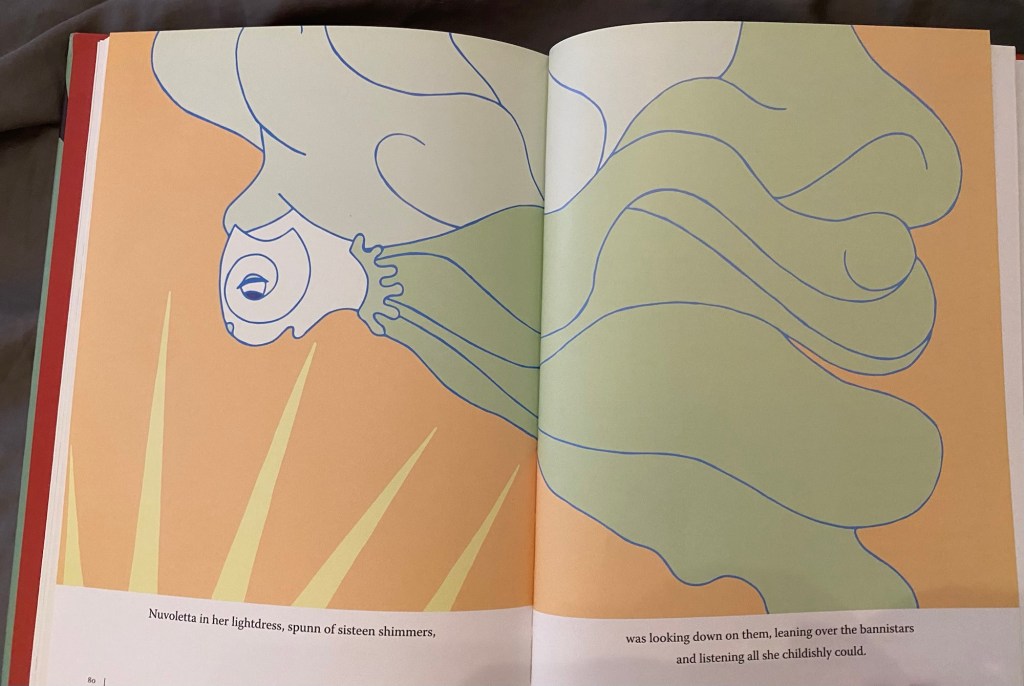
I strongly recommend getting your hands on a copy of this book. McNally’s illustrations enrich the text by showing some of the ways it is possible to visualize the un-visualizable. For example, I enjoyed seeing how the Mookse, who is linked in the text to the Catholic Church and various popes, “vacticanated his ears”:
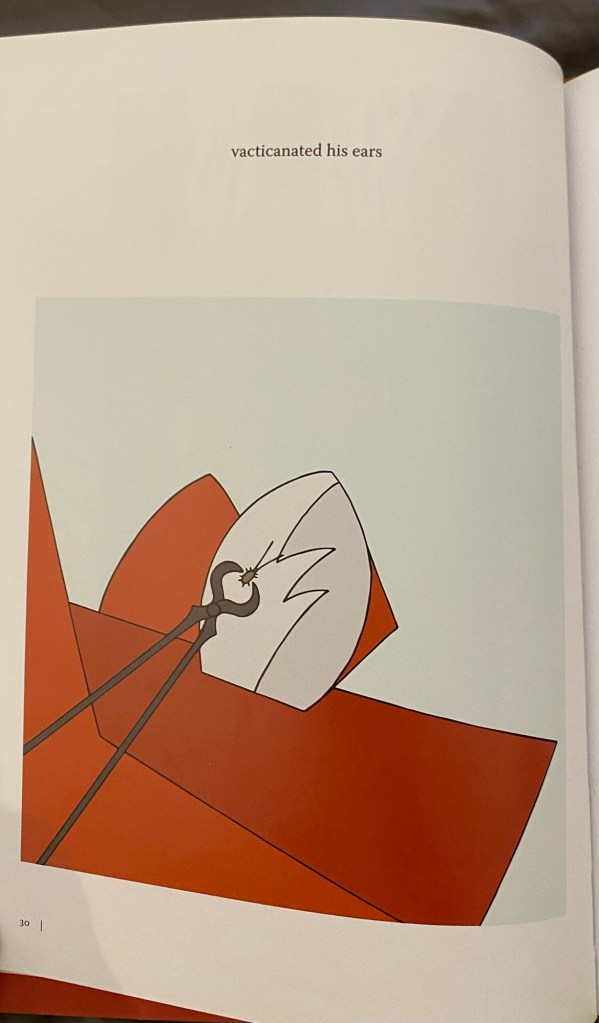
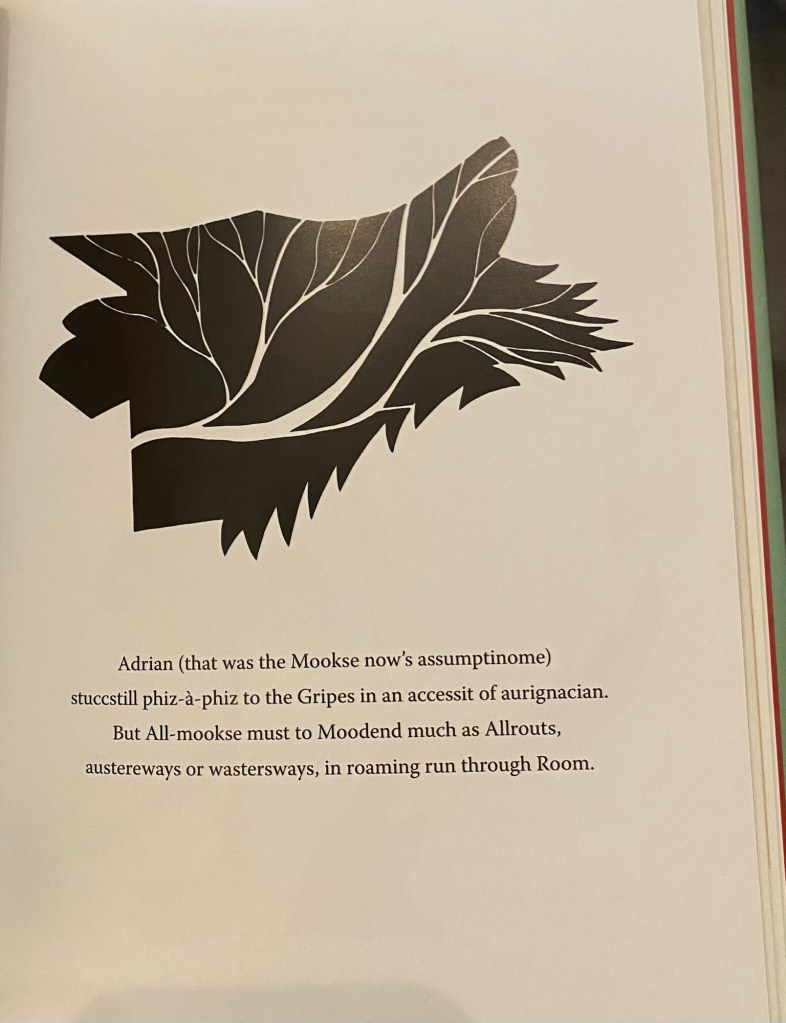
It looks like that’s an earwig in there, connecting back to the Father, HC Earwicker, of whom the sons are distant echoes. The idea that “vacticanate” means “to remove an earwig” is not in Joyce’s text, directly or indirectly, but it’s an interesting association that one can make with the idea of cleaning out the ears (vacate), which is indeed suggested by this word. I also really like the Mookse’s “immobile De Rure Albo,” and the way that the Mookse and the Gripes appear superimposed in this illustration, alluding to their common origin in the father HCE (Stem and Stone, together):
There are many excellent opportunities for contemplation on Joyce’s text afforded by this wonderful work.
I purchased this book in 2020 as an xmas gift for my then-four-year-old daughter (but also for me, of course). I was at the time getting into the habit of buying her children’s versions of various works of world literature, and I thought it was time for Finnegans Wake, which is of course an important book for a four-year-old to know. I figured this volume would make a nice gift for a child to whom I wanted to give a love of literature and learning. Also, by the time I bought the book, I had already introduced her to “The Mookse and the Gripes” by reading aloud brief excerpts of Joyce’s tale, and we had already “played” many times with imaginary versions of the title characters (a note I wrote from this period says that my daughter is “obsessed with the Mookse and the Gripes,” and she “had the imaginary Mookse and Gripes visit us all day”). So naturally I had to buy her McNally’s edition.
The illustrations are fun for a child to look at, and the text is enjoyable as well purely on the level of musical babble. Some jokes are quite accessible. Even a child grasps that the opening is a dream rendition of the traditional beginning of fairy tales — “Once upon a time”…And readers of Joyce have the additional treat of knowing that he’s parodying the opening of A Portrait of the Artist as a Young Man (“…and a very good time it was….”).
I remember my daughter looking through the book in wonder when I first gave it to her. “Did you make this?” she asked. “How did you make this?” I explained that I bought it from an artist.
Looking back on it, I guess I could apply the logic of an “AI Bro” and claim that I did, in fact, make it simply by ordering a copy. I really cannot sufficiently express my contempt for the idea that prompting a machine — or submitting an order — is “making art.” Part of the reason books like Joyce’s and McNally’s speak to me so profoundly is that they are the diametric opposite of AI slop: they are the products of human creativity in dialogue with the world’s creative traditions.
Another stray note I wrote to myself just after xmas that year: “We’ve been reading the Mookse and the Gripes repeatedly. Every time we read the argument between them, she pets the Mookse and says, ‘What a cranky kid!'” She soon wanted to write her own version, “The Dukes and the Moots.”
I don’t remember whose idea it was to copy McNally’s depictions of the characters onto paper, color them, and cut them out to make puppets so that we could play with them. But that’s what we did. And so, we took McNally’s work of art, which drew from Joyce’s, and derived our own versions of the characters, who went off on their own wacky adventures.
Now, how is this kind of derivation different from training an AI program on art and having it produce derivative works, you ask? The main difference is in the conscious experience of encountering art, letting that art interact with our unconscious minds, and experiencing — moment-by-moment — the process of guiding the emergence of new creations. Even if a person were to argue that we humans are just “AIs made of meat” doing functionally the same thing as the machine — which I would dispute — the difference is encapsulated in our conscious experience of process, which is far more than the mere product.
Look at this post, for instance. It started by recounting a specific experience from my memory, and in the process of writing about it and the ideas it calls up, I thought more deeply about and sharpened my opposition to AI “art.” What is valuable is not the post itself but the experience that creating the post enabled. In the same way, what is valuable about Finnegans Wake and The Mookse & the Gripes, as well as the puppets I made with my daughter, is emphatically not the end products themselves but the experiences they facilitate, both of the artists and audiences.
Anyway, back to the puppets. Here they are:
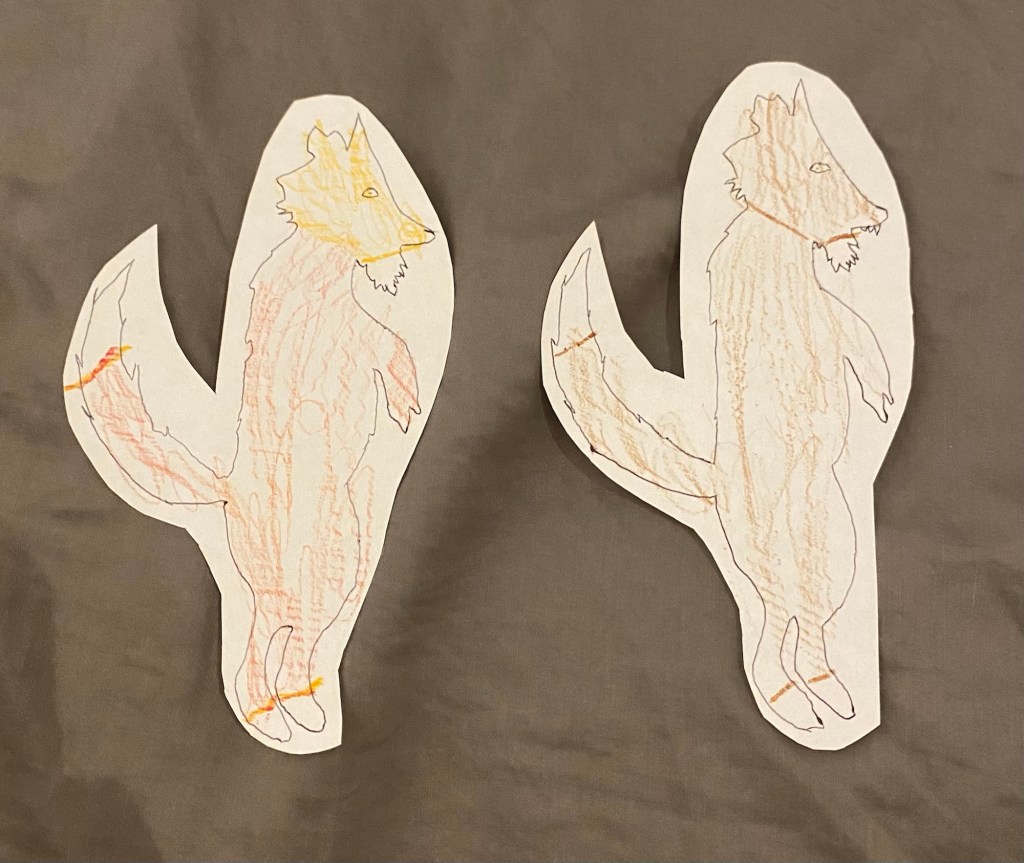
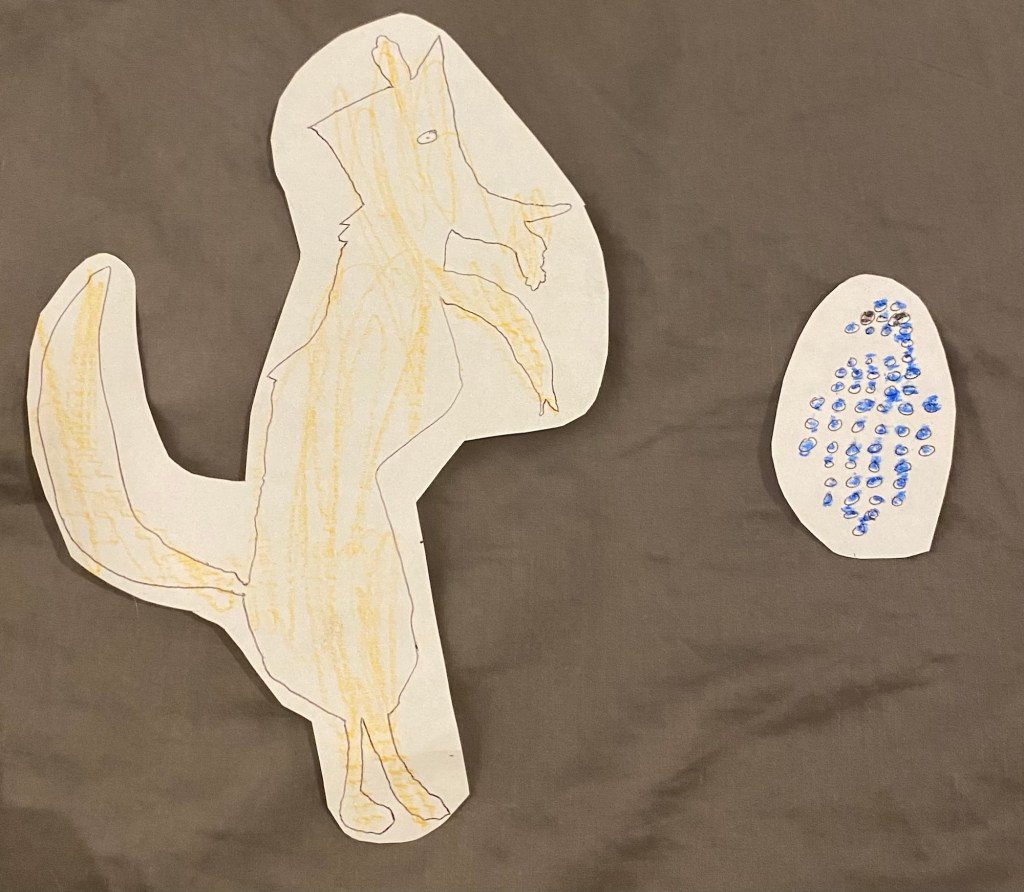
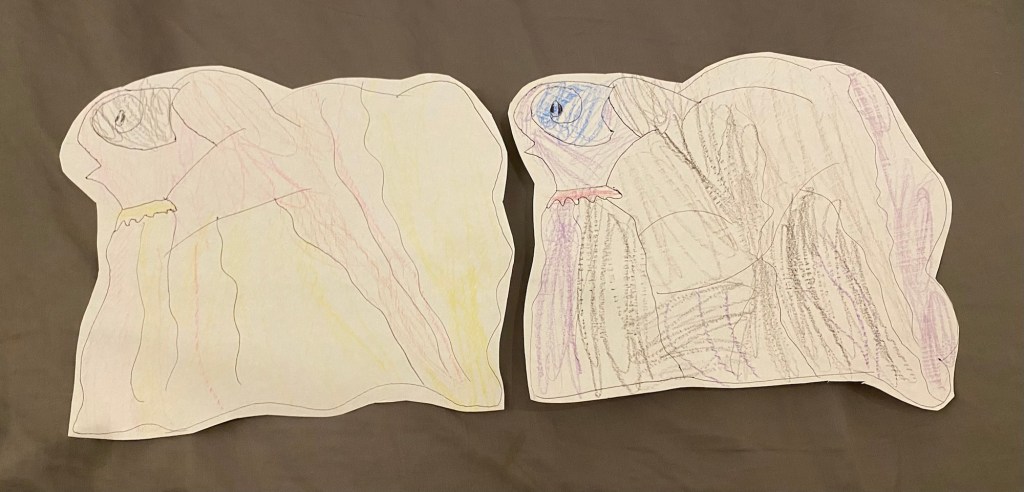
We made multiple versions of these characters, and this led us to create stories in which doppelgangers of the Mookse and the Gripes from a parallel dimension attempt to replace the real ones. This was, incidentally, how my daughter learned the word “doppelganger,” which is of course an important word for a four-year-old to know.
The doppelganger plot was born out of my multiple attempts to draw the Mookse and the Gripes. I am absolutely atrocious at drawing (though every one of my stick figures is infinitely more valuable than the slop crapped out by AI). When we got to Nuvoletta, we deliberately set about to create a doppelganger for her, which became the most powerful character in our world (beginning my daughter’s Joycean tendency to give more power to female characters). According to what we wrote on the back of these puppets, the Mookse’s doppelganger is named “Moose” (and the other one is named “Fox”); the Gripes’s doppelganger is named “Old Blue” (the original Gripes puppet is missing, alas); and Nuvoletta’s doppelganger is named “Luna.”
One detail I recall from these stories is that the “real” characters — from the “original” universe — drink whiskey, while their doppelgangers exclusively drink tap water, and this became a clue that a character had been replaced. Naturally, the doppelgangers believe that they are the “real ones” and are entitled to replace the other ones (this made for a good lesson about perspective for my child, communicated organically and without any cloying lectures). Stories typically involved one character getting replaced and the others going on a rescue mission. I fondly remember how Nuovletta’s doppelganger would imprison the real characters, forcing me to come up with some clever way for them to escape…only to have my daughter sharply shout, “But!” and announce how the doppelganger traps them anew, requiring me to think up yet another escape…over and over and over again. Nuvoletta’s doppelganger was a particularly fearsome foe since, as a cloud (her name means “little cloud” in Italian), she could turn into vapor to avoid damage from weapons (such as the Mookse’s sword) and squeeze through tiny openings.
The stories we told are ephemeral. I can’t really remember their details very well, but the feelings they created in me live on to this day, and they have helped shape my daughter, myself, and our relationship. We enjoyed our natural creativity, in conversation with a great work of art, and with beautiful illustrations of it.
Even if a thoughtless machine could create those same stories we told, it wouldn’t matter. The value is the experience — in the moment, and reverberating through the rest of our lives (and, I suppose, now echoing through this post, and through all the people who read it, and everything they do, and so on and so forth). As it was in the beginning, is now, and ever shall be, art without end….


Hello! This is Matt’s daughter coming from six years in the future. Just pointing out: the Gripes would look like a character in an anime if you added a few lines behind him and put him in a panel. I mean, look at him. He’s got the facial expression and everything.
Great post, but more doppelgängers and less AI. But who am I to say, I don’t really get this literature stuff. I’m more into middle grade fantasy.
LikeLike