
The movie Backrooms made a splash this month, turning a massive profit on a meagre budget of less than ten million dollars. The film is noteworthy because it was made by a twenty-year-old Youtuber, who was also responsible for a series of short videos about the titular extradimensional space.
This post suggests that Finnegans Wake can be read as a kind of “backrooms,” a maze that underlies reality.
The idea of the “backrooms” predated the videos about them. They were an internet legend, consisting of stories told and retold about a mysterious liminal space beyond or outside or under reality, into which people could pass by somehow “no clipping” — a term from video games in which a character “glitches” and passes through objects meant to be solid. That is, through some accident, a person could slip right through our normally solid reality and find themselves in this parallel dimension: and these “backrooms” consist of an endless labyrinth of yellow-wallpapered rooms and bright, fluorescent lights.
Interestingly, the backrooms became a kind of collaborative storytelling project. Initially, the backrooms began as a single post in 2019 by an anonymous internet user on the message board 4Chan, who put up a creepy-looking image of an empty space with a caption explaining the concept:
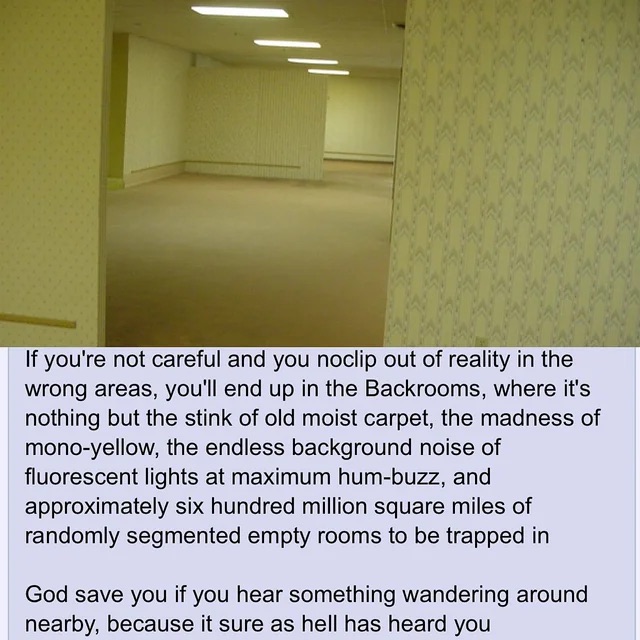
From there, people started expanding the “lore” of the backrooms, and it developed into a collaborative writing project in which people contributed entries describing the various “levels” of the backrooms and “entities” that populate them. During the pandemic, a Youtuber named Kane Parsons started making videos that explored the backrooms in “found footage” fashion. This was a more stripped down version of the backrooms, without any of the lore regarding levels or entities. They were horror shorts that dealt with the scary feeling of being trapped in a “liminal space.” Some of the videos eventually added their own lore, including the idea that a government agency has been investigating the backrooms. Eventually, Parsons was chosen to direct the movie.
Okay, so what does any of this have to do with Finnegans Wake? Basically nothing, except for the fact that the novel celebrates collaborative storytelling and, in places, suggests that Finnegans Wake itself is a kind of labyrinth that is somehow behind reality. I would describe this labyrinth as the “collideorscape” out of which (our experience of) reality emerges: Finnegans Wake contains the archetypes of human storytelling through which we each assemble the narratives by which we experience and understand the world.
The idea that these “backrooms” areas are the source of reality itself reminds me of something Joyce said about the Wake:
I haven’t lived a normal life since 1922, when I began “Work in Progress.” It demands an enormous amount of concentration. I want to describe the night itself. Ulysses is related to this book as day is to night. Otherwise there is no connection between the two books. Ulysses did not require the same amount of concentration. Since 1922 my book has become more real to me than reality, and everything has led to it; all other things have been insurmountable difficulties, even the smallest realities such as, for instance, having to shave in the morning. There are, so to say, no individual people in the book – it is as in a dream, the style gliding and unreal as the way it is in dreams. If one were to speak of a person in the book, it would have to be of an old man, but even his relationship with reality is doubtful.
This is a fascinating idea: that the Wake is “more real” than reality, even the everyday tasks of shaving. To the sculptor August Sutor, Joyce described the writing of the Wake this way: “It’s like a mountain that I tunnel into from every direction, but I don’t know what I will find.”
Finnegans Wake sort of sounds like a “backrooms”-esque extradimensional space, outside of reality — more real than our ordinary reality of everyday life — into which Joyce was digging and exploring.
We, of course, don’t have to take this literally to recognize that the Wake indeed contains some of the archetypes of human storytelling, such that its “characters” recur in all of the stories of literature, history, and everyday life. I’m reminded of how the “Three Soldiers” figures are called the “shavers in the shaw” when sleeping next to Hosty in I.2, or how forms of them talk in II.3 about how they are to “lather and shave and frizzle” HCE.
Or this passage from I.5, summarizing the travails of HCE with a reference to plucking hairs on the chin:
a good clap, a fore marriage, a bad wake, tell hell’s well; such is manowife’s lot of lose and win again, like he’s gruen quhiskers on who’s chin again, she plucketed them out but they grown in again. So what are you going to do about it? O dear!
The process of shaving, then, is but one manifestation of the Eternal Story of HCE: we shave off the hair and back it comes, replaying the tale of fall and rise. And in that shaving, we re-enact the role of the “shavers” of Hosty, the three soldiers who are killing the old man and preparing the corpse for its burial, to rise again.
In this sort of way, we could consider the Wake “more real than reality” — not that our everyday experience is an illusion but that in everything we do, we are acting out an old story that all people before us have already acted out and all people after us will act out again, just with ever new variations, the same anew. One need not believe in anything supernatural to recognize the existence of such patterns.
Finnegans Wake tries to capture that Eternal Story. I’ve written about this before in terms of clothing and the naked body, which is worth exploring (see here for all of the clothing posts). Another way to think about it is to imagine the Wake as a vast backrooms labyrinth in which various entities/archetypes exist: what we call “reality” in our everyday lives can be imagined as a manifestation of these elemental patterns of storytelling.
*
In II.3, HCE is defending the Russian General from the radio play, suggesting that it is the story of all of us, the “overthrew of each and ilkermann of us.” He then describes how he has been reading a “(suppressed) book” on the toilet — this book is Finnegans Wake itself, or perhaps Ulysses, a stand-in for all literature, each work of which manifests some part of the eternal story. It is suppressed by the censors, and perhaps by the rational mind and the Shaunish parts of each of us (and this suppression is emphasized by the parentheses around the word).
HCE’s reading of this book on the toilet is a version of his crime in the Park, which involves relieving himself, spying on two girls, and masturbating (the energies of all of those sources of shame are compressed together in FInnegans Wake, and different aspects of shame are emphasized in different tellings).
As he sits on the “lamatory”/lavatory, casually flipping through the pages of this book (which he describes in ways reminiscent of the girls in the Park), he has a
notion quiet involuptary of that I am cadging hapsnots as at murmurrandoms of distend renations from ficsimilar phases or dugouts in the behindscenes of our earthwork (what rovining shudder! what deadly loom!) as this is, at no spatial time processly which regards to concrude chronology
He feels like he’s catching snapshots of possibilities that have not yet manifested (haps-nots, things that have perhaps not happened but could). He’s also caging them, pulling them out of raw possibility and making them actual (see here and here on possibility and probability in the Wake). These possibilities are the murmurs of distant relations of fictions and similar events — those archetypes that manifest in life. At the same time, they are parts of HCE that have distended from him and emerged as their own individuals in what we call reality, people forming together into nations.
They exist in the archetypes, which we could imagine as a kind of backrooms or “behindscenes,” which exists at no special time (and no space in time) that would allow us to conclude anything about chronology (which is filled with crude things, including the implication in the word “behindscenes” that HCE is looking at the girls’ backsides: “rovining shudder” and “deadly loom” point back to earlier exclamations in the paragraph that describe the girls as a raven and dove).
At the very beginning of II.3, the radio in HCE’s tavern — which is simultaneously HCE’s ear — is described as a kind of labyrinth:
This harmonic condenser enginium (the Mole) they caused to be worked from a magazine battery (called the Mimmim Bimbim patent number 1132, Thorpetersen and Synds, Jomsborg, Selverbergen) which was tuned up by twintriodic singulvalvulous pipelines (lackslipping along as if their liffing deepunded on it) with a howdrocephalous enlargement, a gain control of circumcentric megacycles ranging from the antidulibnium onto the serostaatarean. They finally caused, or most leastways brung it about somehows(that)the pip of the lin(to)pinnatrate inthro an auricular forfickle (known as the Vakingfar sleeper, monofractured by Piaras UaRhuamhaighaudhlug, tympan founder Eustache Straight, Bauliaughacleeagh) a meatous conch culpable of cunduncing Naul and Santry and the forty routs of Corthy with the concertiums of the Brythyc Symmonds Guild, the Ropemakers Reunion, the Variagated Peddlars Barringoy Bnibrthirhd, the Askold Olegsonder Crowds of the O’Keef-Rosses ant Rhosso-Keevers of Zastwoking, the Ligue of Yahooth o.s.v. so as to lall the bygone dozed they arborised around, up his corpular fruent and down his reuctionary buckling, hummer, enville and cstorrap (the man of Iren, thore’s Curlymane for you!), lill the lubberendth of his otological life.
This passage could be explored for some time, just as a labyrinth could. Briefly, the device is worked from a battery that recalls the Magazine Wall in the Park, near the Fall of HCE. 1132 is the number of the Fortunate Fall, and the names after it represent the Cad and Three Soldiers.
The pipelines are “twintriodic singulvalvulous,” recalling the twins Shem and Shaun, plus the Three Soldiers (forms of Shem and Shaun together with their combined form), all of which adds up to the single One, HCE. All these characters are “lackslippling along.” They are lacksidasically sliding through life, relying on the lack of HCE, on whose absence their lacks-living depends, and on which the “deep puns” of the novel relies. [the annotations give “Leixlip,” a village on the Liffey, so there’s that reference too]
Anyway, I could go on for some time, but the action of this machine — which is a communication device, the human ear, HCE himself, and all of Finnegans Wake and human art — is to lull HCE to sleep (the bygone big one around whom they arborise, since he is the Tree of Life or arbor, and they are the people playing beneath the tree or the smaller trees rising up beneath him). And he sleeps until the end of his ontological life, this lover (of ALP) or lubber (a Norwegian Captain married and made into a landlubber, as II.3 chronicles). “Otological” means the study of the ear, and “lil” is the Volapuk word for “ear,” but “lill” reminds me of “till,” as in tilling the earth, and “lubberendth” suggests “labyrinth.”
As HCE sleeps (in his grave), the Three Soldiers till the earth, creating labyrinths in the dirt, tunneling into the mountain that is HCE in order to create art, exactly as Joyce did in writing Finnegans Wake.
Those wild backrooms or “dugouts” into which Joyce tunneled — into which each of us tap when we create, including the everyday creation of our mundane activities — are reiterated in everything, including the labyrinth shape of the ear or electronic devices, through which we hear those inspired words of art, the inspiration captured in books that Shaunish types try to suppress but that nevertheless give us notions of a behindscenes of our earthwork.

