
I’ve recently returned to my re-reading of A Portrait of the Artist as a Young Man, and I’m finding the final chapter more interesting than ever before — and funnier! I’ve laughed out loud several times reading it, including one scene that I’ll discuss here in this post, a scene in which a strange character repeats himself. I compare it below to a recurring gag on my favorite television show, The Sopranos, and I reflect on the significance of Joyce repeating a moment from his own life, enshrining it in art in a way reminiscent of what William Wordsworth called a “Spot of Time.”
Close readings of Joyce, reflections on life, and fragments of pop culture — all this and more on today’s post!
One of the moments that made me laugh in Chapter V is when college-aged Stephen has a showdown with a student named MacCann, who is eagerly encouraging his fellow students to sign a petition in support of world peace (based on a plan proposed by the Russian Tzar). When Stephen refuses, they exchange words, and a group gathers around them, including a dark-complected young man named Temple (described by Joyce as “gipsylike”):
A little ring of listeners closed round to hear the war of wits. A lean student with olive skin and lank black hair thrust his face between the two, glancing from one to the other at each phrase and seeming to try to catch each flying phrase in his open moist mouth.
A little later, after he’s grabbed by another student:
Temple struggled to free his arm but continued, his mouth flecked by a thin foam
On this read, I was so tickled at the idea of this kid turning his face from one person to another, gawking like a cartoon character. And I was far more tickled at the idea that this incident must have stuck in Joyce’s mind, and that he could never forget the detail of how wet this kid’s mouth was.
One of Stephen’s witty remarks comes as he points to a picture of the Tzar near the petition:
—Keep your icon. If we must have a Jesus let us have a legitimate Jesus.
—By hell, that’s a good one! said the gipsy student to those about him, that’s a fine expression. I like that expression immensely.
He gulped down the spittle in his throat as if he were gulping down the phrase and, fumbling at the peak of his tweed cap, turned to Stephen, saying:
—Excuse me, sir, what do you mean by that expression you uttered just now?
Feeling himself jostled by the students near him, he said to them:
—I am curious to know now what he meant by that expression.
I was reduced to a fit of laughter by reading this. Here’s this kid’s wet mouth again, and then he turns and repeats himself, again almost like a cartoon character.
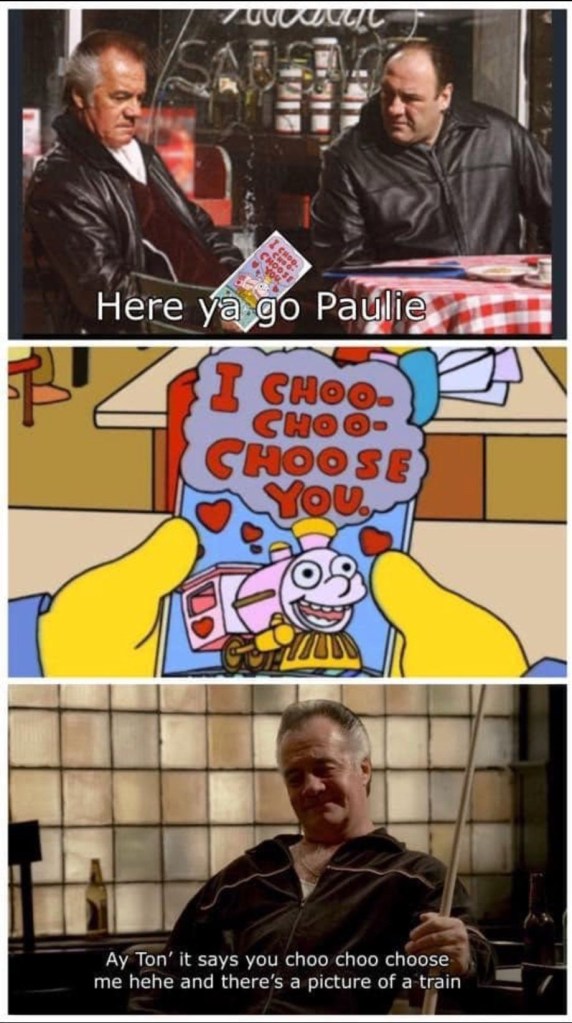
It puts me in mind of Paulie Walnuts on the Sopranos, who at least three times in the course of the series makes a joke and then turns to a nearby character, who has clearly just heard him, and says, “Didja hear what I said?” And then (at least the first two times) he repeats his own joke word-for-word. The implication is that he does this all the damn time (Tony confirms during one of his therapy sessions that Paulie is supremely annoying, even though he’s “one of my top guys”).
During the third repetition of this gag in the series, Paulie’s rhetorical question is actually answered. He has just pointed at two rotund gentlemen having a conversation at a party and remarked that the sight of them next to each other is “like an ad for a weight loss center: Before…and Way Before.” Noticing Tony Soprano passing by, he asks his usual question: “Didja hear what I said, Tone? It’s like an ad for a weight loss center.” Tired and intoxicated, Tony dismissively mumbles, “Yeah, before and after.”
I love this. The irony is that this is the wittiest joke Paulie makes in the entire series, and Tony actually missed it! The one time someone answers Paulie’s rhetorical question, and prevents him from repeating the full remark, the answerer misses out on a good joke because he presumes it’s a dumber joke than it was.
Joyce’s character Temple is doing a Paulie-like repetition. But in writing this scene in Portrait, Joyce himself is repeating something from his own life, allowing himself to experience the memory again as he transubstantiates it into art, where it will live forever.
I am put in mind of William Wordsworth’s “Spots of Time,” which I’ve discussed before on this blog (here):
There are in our existence spots of time,
That with distinct pre-eminence retain
A renovating virtue, whence–depressed
By false opinion and contentious thought,
Or aught of heavier or more deadly weight,
In trivial occupations, and the round
Of ordinary intercourse–our minds
Are nourished and invisibly repaired;
A virtue, by which pleasure is enhanced,
That penetrates, enables us to mount,
When high, more high, and lifts us up when fallen.
This efficacious spirit chiefly lurks
Among those passages of life that give
Profoundest knowledge to what point, and how,
The mind is lord and master–outward sense
The obedient servant of her will.
I summarize Wordsworth’s point in that post by saying that these spots are “moments of the past that can live again for us, to lift us from our low moods and nourish and repair the mind.”
Of course, the difference is that Joyce isn’t recalling a peak experience here: he’s just representing a mundane experience, while Wordsworth’s spots all have the characteristic of being moments that impress themselves on the mind as significant. I guess the “bird girl” passage from Chapter IV of Portrait would be closer to a Wordsworthian spot of time.
I’m starting to think that Joyce develops Wordsworth by stressing how any moment of the past (even, or especially, the mundane) can stand out in the memory and — being accessible to us in the way that the Wake suggests all of the past is — become a source of renewal as Wordsworth would have it…and also become a source of reflection, aesthetic contemplation, and artistic creation. True, some of Wordsworth’s moments seem pretty mundane (“It was, in truth, / An ordinary sight,” he writes about one such moment in the 1805 Prelude), but you get the sense that they were significant experiences to him even at the moment he experienced it. I’m not sure Temple’s wet mouth and weird repetitions registered to young James Joyce in that way at the time.
Yet Joyce affirms that an artist can pluck some mundane, silly moment like that out of the past and build it into art. In this way, Joyce’s version of spots of time are an extension of his idea in Ulysses that “Any object, intensely regarded, may be a gate of access to the incorruptible eon of the gods.” That this phrase is possibly spoken by Buck Mulligan in a mocking tone just reminds us that much truth is said in jest. If any memory can be such a gate, then it is useful that all of one’s own experience, as well as all of human history, is always available, at every moment, to a mind that learns to “read” history in the way that the Wake teaches, in which all of history is overlaid onto the present moment, the entirety of human experience — the past, present, future; the falls and rises — available at once.
Readers interested in exploring these ideas further might be interested in Chapter 8 of my book Romantic Epics and the Mission of Empire (available now wherever fine books are sold). There, I suggest that William Blake advances a similar idea to Wordsworth, that all of the past is accessible to the creative imagination (and I trace this idea back to epic tradition by way of Milton’s Paradise Lost, and ideas of interiority in some religions). Crucially, the difference between Blake and Wordsworth is that Blake sees memories not just as moments in time that the imagination can still access to refresh us — he sees them as something like traps, where inferior imaginations can get stuck, dully reiterating the past rather than creating something new — both artistically and, perhaps, politically for the world.
Where does Joyce fit into this schema? I consider Joyce closer to Blake. He’s not positioning himself hierarchically “under” the past, as Wordsworth might be seen to be doing, asserting the present’s dependence on (or echoing of) the past. Nor does he, like Wordsworth, say that he is merely enshrining the past. Joyce is doing something closer to Blake’s challenging of, and explosion of, temporal categories, asserting both the sovereignty of the present and our access to what we call the past, along with our access to a potential, a series of possibilities, that is inherent in the moment, the possibilities of the creative imagination to transform the world. For Wordsworth, the past is gone, and so are its glories, but we can recall it to enshrine it for the future. For Blake and Joyce, the past is right here along with the present and all the possibilities of transforming our experience, all “one present tense integument.” I consider this the secular version of Adam surveying all of history at the end of Paradise Lost. There’s much more to say about this, and possibly a book project about it some day. Stay tuned.
In the meanwhile, as I was contemplating these subjects, I was struck by the idea that a meme — an internet image that pairs a picture with text for typically comedic effect — functions something like a spot of time, or one of these moments that Joyce pulls out of his life, or even a lyric poem: it arrests a moment in time, or a thought in time, and converts it into art, lifting it out of the temporal and into the eternal.
That sounds like a high falutin’ way of talking about something so silly, but is it any sillier than recreating in a novel an argument over signing a petition and calling attention to someone’s wet mouth and ridiculous repetitions? Who’s to say that a meme is not a commemoration of a moment of thought that joins together elements of the world, repeating and recreating them for our aesthetic upliftment, assisting us in accessing that initial moment of amusement once again, serving as a gateway to the incorruptible eon of the gods?
With that in mind, here’s my favorite Paulie meme that joins The Sopranos together with The Simpsons:
My forthcoming article in Joyce Studies Annual examines Finnegans Wake through the lens of memetics, the study of memes understood as units of culture that reproduce and transform.
More to come on the subject of ridiculous things that are (possibly) profound.

