
I am a part of all that I have met;
Yet all experience is an arch wherethro’
Gleams that untravell’d world whose margin fades
For ever and forever when I move.
–Lord Tennyson, “Ulysses”
This post looks at the concept of doorways in Finnegans Wake and in literature more broadly.
I recently read Howl’s Moving Castle with my daughter. I had never read this 1986 fantasy novel before, nor had I seen the well-known anime film of the same name. The book is utterly charming and engaging. [The film, while beautifully animated, is almost unrelated to the book: it borrows some ideas and character names, but it tells a very different story. I greatly prefer the book].
One of the most important images from the story is a door. The titular moving castle has a door that opens into four different locations. A knob over the door inside the castle can be turned to four different positions, each causing the door to open onto one of the locations.
This door is more than a convenient storytelling device to zip the characters rapidly from place to place. There are other ways for them to travel quickly, from “seven-league boots” to magical wind. The door is a potent image as a passageway from one place to another (or, symbolically, from one frame of mind to another), a threshold to be crossed.
In the back of my edition, there’s an interview with the author, Diana Wynne Jones. One of the questions is “Doors that open onto many different places figure prominently in Howl’s world. What makes doorways so powerful and mysterious?”
What a great question! The author notes, “Doors are very powerful things. Things are different on either side of them. This applies not only to magic portals […] but it applies to quite ordinary doors too.” That’s a good start. But I don’t love the rest of the answer, where she says that there’s “always a chance” that a familiar door in everyday life may open onto a place you’ve never seen before, including into Bluebeard’s garden (?). She notes that in the magical world of Howl, things like that can actually happen, but she says there’s “no guarantee” that our world is not like that.
Hm. Taken literally, that’s a silly thing to say. I guess I technically can’t be 100% certain that my front door won’t suddenly open into Bluebeard’s garden one day — but I technically can’t be 100% certain of anything. To the degree that certainty is possible, I am as sure as I can be that my door won’t suddenly take me to a new place.
But let’s give her the benefit of the doubt: I actually can’t know what possibilities are lurking on the other side of a door. When I step through my front door in the morning, I don’t know whom I might meet or what kind of day I could have. Anytime I step through any door at all — even a door I’ve gone through tens of thousands of times — I’m confronting a unique configuration of the world, where even if it seems familiar, all of the molecules have shifted positions at least somewhat and where I am a new person encountering that new configuration, having had new experiences and memories since the last time I passed through that same door. “You cannot step into the same river twice,” said Heraclitus. The river has changed since last time, and so have you. So you also cannot step through the same doorway twice.
Therefore, in a figurative sense, a door always leads to a new world with new possibilities. Maybe that new world and its possibilities will be so similar to ones you’ve seen before that an unimaginative person will see it as the “same old, same old.” But maybe there’s always an adventure if you know how to look.
The Ulysses of Tennyson’s poem, quoted at the start of this post, figures all experience as such a portal. The horizon is always retreating as we move forward: there’s always more to explore, more untraveled land. This is an image of infinity and infinite possibility.
It reminds me of William Blake’s idea of the “vortex.” In Milton: A Poem, a passage lays out the “nature of infinity,” where every object and person and idea is surrounded by an imaginary whirlpool through which a traveler can enter:
The nature of infinity is this: That every thing has its
Own Vortex; and when once a traveller thro Eternity.
Has passd that Vortex, he percieves it roll backward behind
His path, into a globe itself infolding; like a sun:
Or like a moon, or like a universe of starry majesty,
While he keeps onwards in his wondrous journey on the earth
Or like a human form, a friend with whom he livd benevolent.
I actually have an article coming out later this year in Vala, the journal of the William Blake Society, in which I discuss this passage. [Edit: You can read the article here, pages 8-13] But the gist of my article is that Blake considered everything — every person, object, idea, work of art, word — a doorway to infinite possibilities, which each of us can imaginatively access and explore. Under this view, all things are doorways through which we are passing all the time, and we can cultivate friendship with all things, discovering ever more potential, and coming to know the entire universe intimately.
And I don’t mean this in some sit-around-and-gaze-at-your-navel sense. We explore infinite possibilities in the concrete, material everydayness of our interactions, in what Blake elsewhere calls “Minute Particulars”: in the specifics of embodied experience, not generalized abstractions.
For Blake, discovering infinite potential includes especially artistic creation — which encompasses poetry, painting, sculpting (maybe even blogging?) — but he doesn’t put art in a separate category from the everyday labor of our daily lives and relationships. There is more art in preparing and sharing a good meal with a loved one than in a thousand attempts to copy the Renaissance painters.
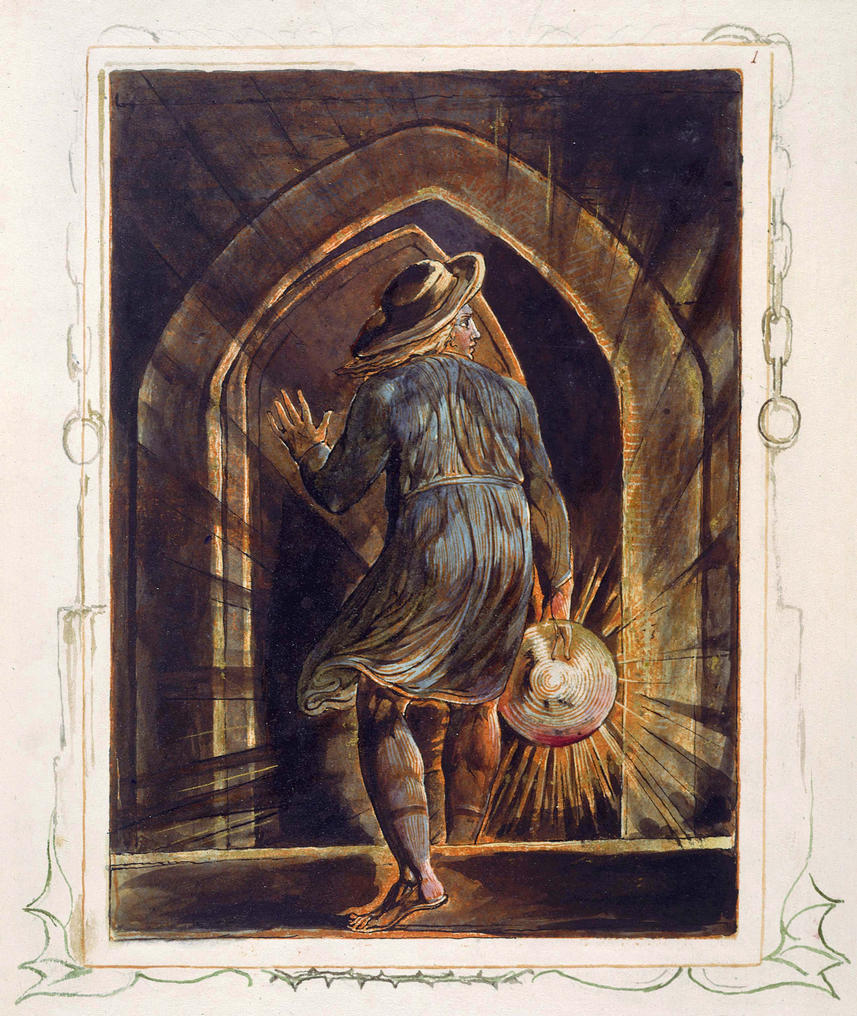
Blake’s Los prepares to enter a doorway
Anyway, the point is that everything is potentially a doorway. All experience entails crossing a threshold to untraveled worlds, where there is always more and more to explore. More to find out, more to share, more to create. A well-lived life is the greatest work of art, and its work is endless.
Finnegans Wake too is such a doorway. The blog “Finnegans, Wake!” had a post a few years ago entitled “The Portal.” I encourage everyone to read it because it makes a lot of great points (and, I can’t help but notice, it is topped with a Blake image).
If I could distill that post down into a couple of important takeaways that connect to my points in my own post here:
The door in Finnegans Wake is a threshold wedged between the world of wakefulness and deep sleep. The book itself is also represented like a door or gate, the sigla Joyce uses for the book is a square ▢ a type of portal.
[…]
dualities and their powerful conflicts tend to cluster around gates, doors, thresholds in the book. The angry drunk guy berating HCE at the door is an opposing force, a polar opposite of HCE the sleeper himself.
What the blogger describes as “dualities” I have referred to in my posts as William Blake’s “contraries.” And what the blogger calls the “angry drunk guy” I have called a form of the Cad, a proto-Shaun figure who represents, among other things, the ego/Selfhood, into which the unified Self falls, as we feel and fall into a perception of the world as a zero-sum game of conflicts.
The “Finnegans, Wake!” post is well worth a read with these ideas in mind. I would develop it by noting that practically each word of Finnegans Wake can act as such a doorway: each possesses a vortex that a reader can enter, through which the reader can be transformed and come to know the book, and the universe in daily life, better and better. Many of my posts on this blog involve traveling through such vortices/doorways and touring the world inside. Take, for instance, my post diving into the inner world of the word “Shikespower.”
*
The doorway in Finnegans Wake also symbolizes the erotic energies of humanity, which can be a powerful tool for shifting perspective. I.3 notes that HCE (or the Cad) claimed that when he was caught doing his misdeed (or was caught attacking HCE), he was
only falling fillthefluthered up against the gatestone pier which, with the cow’s bonnet a’top o’it, he falsetook for a cattlepillar with purest peaceablest intentions
“Pier” here can mean the posts or pillars of a gate (as well as a launching point for the ship of life). “Pierre” is French for “stone.” This gate is also a monolith stone, which symbolizes his own erection. Like a caterpillar, humanity’s erotic energy contains its infinite potential for transformation. [As cattle, HCE is a symbol of virility, a sacrificial animal, and a cuckold with horns all at once. Cf. Hosty’s Ballad about HCE in I.2: “Like the bumping bull of the Cassidys / All your butter is in your horns.” As ever, HCE’s fall entails music and art, as “fillthefluthered” recalls the song “Phil the Fluter,” which sounds throughout the book]
And further, he was
merely trying to open zozimus a bottlop stoub by mortially hammering his magnum bonum (the curter the club the sorer the savage) against the bludgey gate
This is from the part of the novel where HCE and the Cad are starting to bleed into each other as the dreamer’s consciousness is increasingly inhabiting those who accuse him, sinking into an egoic, Shaunian perspective.
HCE/Cad claims he was just trying to open a bottle of stout by hammering it against a gate, a bloody gate, which is also the crime of bludgeoning someone/himself.
Since a gate can also symbolically be a vagina (Blake calls it the “Gate of Luban,” by which we pass into this world), this passage is a sex joke. But his “magnum bonum,” with which he bludgeons the bloody gate, is not just a laugh-out-loud moment. It announces once again the theme of the Fortunate Fall: our transgressions are a Great Good that necessitates the greater good of Redemption (or, more secularly for those who are as non-religious as I am, learning how to cut each other some slack and not hold grudges, or at least not grasp them so tightly — to shift out of the mode of seeing everything as a zero-sum competition).
Here, the gate is a portal or vortex through which HCE can be converted into his inverse/Cad, reflected by the words “convorted” and “provorted” in the Prankquean episode, where the PQ does just that to HCE’s sons, switching one into the other and producing Tristan/Cad. The doorway/vortex is the meeting point of contraries. It is the place where selfish and Selfless perspectives meet, where the Fall and the Redemption are mirrored on either side. To put it in terms of another of my posts, the doorway represents the ability to turn your eyes differently toward reality, choosing to perceive it as Hell or Paradise, as a zero-sum world of conflict (produced by the mind’s tendency to grasp) or as a riverrun of creativity that embraces impermanence.
Elsewhere, the door is an image that expresses another pair of contraries: both protection (locking HCE into Stonehenge/his coffin for his own good, repressing painful thoughts, and locking away the dark contents of the dreamer’s mind) and vulnerability (offering the potential to expose that repressed material to the light of day — or, rather, the dark of dreams).
Hence, the Four Old Men ask John in II.4 to “oben the dure” to behold the lovemaking of Tristan and Isolde, that image of cuckolding/replacement by the son/death anxiety that the dreamer’s mind is trying to repress as it incessantly returns to it. Hence, the Four Old Men at a critical moment in III.4, where they uncover the lovemaking of the parents — the same scene as II.4, just viewed from a different vantage point — have the following important exchange, opening the door:
—Her door!
—Ope?
—See!
—What?
—Careful.
After this comes a paragraph detailing unconscious desires and anxieties of utter depravity (whose filthiness is rendered in the dry language of legalese).
The doorway holds back what we would prefer not to face, our anxieties and all of the unflattering parts of ourselves and of humanity more generally. But it is only by opening doors and passing through them that we learn more about the world and ourselves (including what Jung called the Shadow), and come to know all of it more intimately.
Finnegans Wake is such a doorway. It is a gate, portal, vortex. Each of its images, characters, chapters, and even each of its words is a magical portal that can lead us deeper within the infinite possibilities of the universe and the self.
*
In Howl’s Moving Castle, one of the funniest revelations is the fact that Howl comes from modern-day Wales, which is one of the locations the castle’s door leads to. That is to say, this magical door has a way of opening into *our* world.
When Sophie — whose name means wisdom — opens the door to our world and sticks a finger into it, recalling the curious Pandora, she lets in a curse that afflicts Howl, a curse that appears in the form of a John Donne poem. That poem (“Song: Go and Catch a Falling Star”) is also something of a figurative doorway that the characters must enter in order to overturn from within: only the first stanza enters the castle, and it says at the bottom, “Decide what this is about / Write a second verse yourself.”
Challenge accepted. As fans of the novel have noted, the characters must overcome the misogynistic assumptions of the poem as surely as they must overcome the ideas they have internalized about themselves (see here and here for examples of such readings). Indeed, the novel shows how characters are shaped by the stories they tell themselves about themselves, which is a point that Finnegans Wake makes as well.
And the door of Howl’s castle proves itself to be — like every doorway and vortex, if we have the imaginative ability to enter and truly engage — a way out and a way in at once, a means for us to explore the world and for the world to explore and change us. By opening the door, Sophie lets in the magic that drives the rest of the adventure.
There is a Native American saying that Joseph Campbell liked to quote. “As you go the way of life, you will see a great chasm. Jump. It is not as wide as you think.”
Maybe we can revise that: as you go the way of life, you will often come to a door. Go through it. The world beyond is more familiar, and stranger, than you think.
 The Suspended Sentence
Pingback: Blake’s Vortex and Finnegans Wake | The Suspended Sentence
Pingback: We Are Not Going to Talk about Judy…. | The Suspended Sentence