
This post considers the symbol of the cross in Finnegans Wake.
Chapter I.1 discusses the work of ALP, who gathers up the pieces of the Fall (all spoiled goods) as her spoils. The paragraph contains hints of the Letter ALP writes, concluding with four Xs or crosses (which inspired the Tunc page of the Book of Kells, which I discuss here):
all spoiled goods go into her nabsack: curtrages and rattlin buttins, nappy spattees and flasks of all nations, clavicures and scampulars, maps, keys and woodpiles of haypennies and moonled brooches with bloodstaned breeks in em, boaston nightgarters and masses of shoesets and nickelly nacks and foder allmicheal and a lugly parson of cates and howitzer muchears and midgers and maggets, ills and ells with loffs of toffs and pleures of bells and the last sigh that come fro the hart (bucklied!) and the fairest sin the sunsaw (that’s cearc!). With Kiss. Kiss Criss. Cross Criss. Kiss Cross. Undo lives ’end. Slain.
The four Xs could stand for the three crucified victims of the Gospel account, along with one big cross to sum up the entire story of redemption. In the scheme of the Wake, it could signify HCE and the three men who comprise him him, his two halves and their union (Shem, Shaun, and the shame that sunders’em).
In short, the cross is a sign that Here Comes Everybody.
As the narrator of I.5 describes the Letter:
that last labiolingual basium [X, a kiss…a kiss cross] might be read as a suavium if whoever the embracer then was wrote with a tongue in his (or perhaps her) cheek as the case may have been then
We’re told earlier in I.5, in a description of the Letter, about the line ruling of the page:
Such crossing is antechristian of course, but the use of the homeborn shillelagh as an aid to calligraphy shows a distinct advance from savagery to barbarism.
“Antechristian” suggests both before Christianity and *anti* Christian, perhaps even in the Nietzschean sense.
Perhaps the cross of Finnegans Wake has a meaning diametrically opposed to its meaning in Christianity.
As an instrument of death, the cross represents the Fall explored in Finnegans Wake, but it’s also a symbol of Redemption: it signifies destroying the lower self or the ego or Blake’s Selfhood or whatever you want to call it — or we could say it represents what Nietzsche called “self-overcoming.”
As a symbol of both the Fall and the Redemption, it is the equivalent of the phallus, which — as I discussed in my last post — also serves as an emblem of both, a Wound Worker and a Wonder Worker. And again, it need not denote a literal penis: it can stand for the sexual energies of all humans; it’s the libidinous urges that can lead us to hurt each other or to help and redeem each other. As it’s put in Shem’s marginal comment in II.2, “Hearasays in paradox lust.” [Heresies in Paradise Lost, which might include Milton’s idea that Paradise included sexual intercourse]
And just as the brothers Shem and Shaun have their fallen versions of the telescope, as I discussed in that last post, so too do they have the fallen versions of the cross or phallus.
Shaun wields the “deathbone”:
He points the deathbone and the quick are still. Insomnia, somnia somniorum. Awmawm.
Shem wields the “lifewand”:
He lifts the lifewand and the dumb speak.
—Quoiquoiquoiquoiquoiquoiquoiq!
The final chapter of Finnegans Wake calls back to both lines:
Death banes and the quick quoke. But life wends and the dombs spake!
The fact that the cross or X is a vehicle of both the Fall and Redemption is summed up on the last page of II.2 (discussed here), when the monosyllables are counting down the page, ending in Geg (10), the manifest world. Attached to the word Geg is a footnote, right before the words “Their feed begins” (the feast of life, the feast at the Wake). In the margins of that footnote is this drawing:
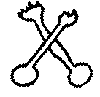
The utensils are crossed like a skull and crossbones. Death and life joined together. An X. A kiss.
The footnote reads,
And gags for skool, and crossbuns and whopes he’ll enjoyimsolff over our drawings on the line.
There’s a lot packed into this sentence. “Gags” could mean jokes, but it also implies gagging on food (paired with the syllable “Geg”) (and maybe it further implies “gagging for it,” an expression for being horny); “crossbuns” is food, but it is maybe also the buns of the posterior, as in the Tunc page “Suavium.” The word “hopes” is mixed with whooping (with joy) and/or with whoops, as in the sound when people have made a mistake. The phrase “enjoy himself” looks like “enjoy I’m sol,” which reminds us that the sun is the source of energy for planet earth; to eat is literally to consume solar energy. And “drawings” could also mean like a raffle, like the random chance of the universe, while “on the line” can also mean “at stake.”
As the artist’s lifewand — or pen — the cross/phallus is the destruction of our worst selves and the acting with passionate, creative intensity that (for William Blake) is the true imitatio Christi. It is Blake’s idea of true Christianity: the liberty of body and mind to exercise the divine arts of the imagination, to truly embrace and forgive the Other because we realize that the Other is already in us: Here Comes Everybody.
It’s about as “antechristian” a message as you can get. That is, it’s an eternal message that precedes (ante-) all religions, and it’s also a message opposed to the orthodox doctrines of many forms of exoteric religion.
*
Another reference to crosses occurs during the cross-examination of Yawn in III.3.
In the earlier cross-examination of I.4, it’s called a “crossexanimation.” The word suggests that the cross, the X, is responsible for the animation of life.
During III.3, the witness suddenly transforms into one of the original balladeers against HCE — who are also the three soldiers — and describes how they approached a Mr. Coppinger “with reference to a piece of fire fittings”…I initially on a first read thought that phrase meant a piece of wood, but a google search suggests that “fire fitting” is part of a fire hose or sprinkler.
He gives them an explanation
touching what the good book says of toooldaisymen, concerning the merits of early bisectualism, besides him citing from approved lectionary example given by a valued friend of the name of Mr J. P. Cockshott, reticent of England
The three men approaching Coppinger is another version of the Cad encountering HCE or the three soldiers attacking him. Bisectualism refers to HCE’s division into two, the warring sects represented by Shem and Shaun, but it also suggests bisexuality, HCE’s indiscretions with both the girls and the boys in the Park. I will allow the name Cockshott to pass without comment.
Coppinger says how Mr. Cockshott saw a
cunifarm school of herring, passing themselves supernatently by the Bloater Naze from twelve and them mayridinghim by the silent hour.
I originally thought that these are the girls who are manifestations of Issy, the 28 girls of the month (making her the 29th, the leap year girl — incidentally, a leap year is also called a bissextile, which is another meaning of “bisectualism”). But I poked around some sources that say there are twelve of them, whose actions listed below correspond to the zodiac signs.
These little fishies show off their tails for him. Again, this requires little comment:
Butting, charging, bracing, backing, springing, shrinking, swaying, darting, shooting, bucking and sprinkling their dossies sodouscheock with the twinx of their taylz. And, reverend, he says, summat problematical, by yon socialist sun, gut me, but them errings was as gladful as Wissixy kippers could be considering, flipping their little coppingers, pot em, the fresh little flirties, the dirty little gillybrighteners, pickle their spratties, the little smolty gallockers
“Errings” sounds like herrings…these fish were gladful, but so were their misdeeds, their errors. The Fortunate Fall again. How wonderful that people sin, so as to necessitate the greater good of forgiveness and redemption.
all them little upandown dippies they was all of a libidous pickpuckparty and raid on a wriggolo finsky doodah in testimonials to their early bisectualism
So the girls were all flirty and dirty and libidinous, and they committed a wrong too, but there was something glad and joyous about the whole thing.
Given the etymology of “testament,” I suspect “testimonials” and “doodah” to be sexual terms here as well.
At last, a reference to the cross appears:
Such, he says, is how the reverend Coppinger, he visualises the hidebound homelies of creed crux ethics.
The ethics of the cross. This all lines up nicely with the cross as instrument of the libido, a vehicle of the Fall and the Redemption.
He ends by appending a kind of moral:
Watsch yourself tillicately every morkning in your bracksullied twilette. The use of cold water, testificates Dr Rutty, may be warmly recommended for the sugjugation of cungunitals loosed. Tolloll, schools!
That’s “wash yourself” and “watch yourself”…in the toilet and in the twilight. I may have more to say about this passage in future posts, but for now, my only comment is that it seems to indicate both sides of the libido, revving it up and cooling it down, both sides simultaneously attributed to the Fall and Redemption (“Hearasays in paradox lust”).
After this, HCE becomes a Salmon in a verse of the ballad:
—There’s an old psalmsobbing lax salmoner fogeyboren Herrin Plundehowse.Who went floundering with his boatloads of spermin spunk about.
Leaping freck after every long tom and wet lissy between Howth and Humbermouth.
Our Human Conger Eel!
They tell Hosty, the singer of this ballad, that “Hump’s your mark” — Hump(hrey) Chimpden Earwicker and King Mark are identified. Three Quarks for Muster Mark, and all that. And then they catch the old Salmon in their net.
*
There’s one more reference to the cross I want to discuss here, from ALP’s magnificent final monologue. She tells her husband that they’ll sit down by the ocean
And watch would the letter you’re wanting be coming may be. And cast ashore. That I prays for be mains of me draims. Scratching it and patching at with a prompt from a primer. And what scrips of nutsnolleges I pecked up me meself Every letter is a hard but yours sure is the hardest crux ever.
So…HCE also stands for “Hardest Crux Ever.”
Given all the phallic associations of the cross, this is yet another dirty joke, but HCE is also the crux of the entire book.
That idea of Here Comes Everybody: that glorious, inclusive, wide-ranging vision that implicates and celebrates us all. That’s the crux of the whole matter, and it’s the hardest nut to crack. [Or, Finnegans Wake itself is the hardest nut to crack]
She scratched and pecked/picked up knowledge from the Letter (the hen who finds the Letter, which is Finnegans Wake, buried underground like the Book of Kells, pecking at the ground)
Nutsnolleges — knowledge (of the libido) that comes from the nuts/testes, testaments (the highest sense of the Gospels/the Letter/literature)
But also the nuts of knowledge in Irish folklore, which were eaten by the Salmon of Wisdom, which was caught and consumed by…you guessed it…Finn MacCool.
The great Salmon himself, the one who spied all those tempting fishies.
The fish is the symbol of Christ. Or as Joyce says in Ulysses, “God becomes man becomes fish.”
A pretty nice kettle of fruit.
 The Suspended Sentence
Pingback: Leafy Speaking, Part 2 | The Suspended Sentence
Pingback: Your Own Finnegans Wake? | The Suspended Sentence