
Finnegans Wake Chapter I.5 discusses the marvelous and confusing letter of ALP (which represents Finnegans Wake itself). Joyce extensively compares the Wake to the Book of Kells, an Irish artifact of exquisite beauty: it’s a medieval copy of the Gospels that is lavishly illuminated.
This post briefly examines how Finnegans Wake makes use of the Book of Kells, and especially its “Tunc Page.”
The illustrations in the Book of Kells are wild and dreamlike, not unlike the Wake. Here’s an example of a stunning Chi Rho with twisting, self-similar patterns:
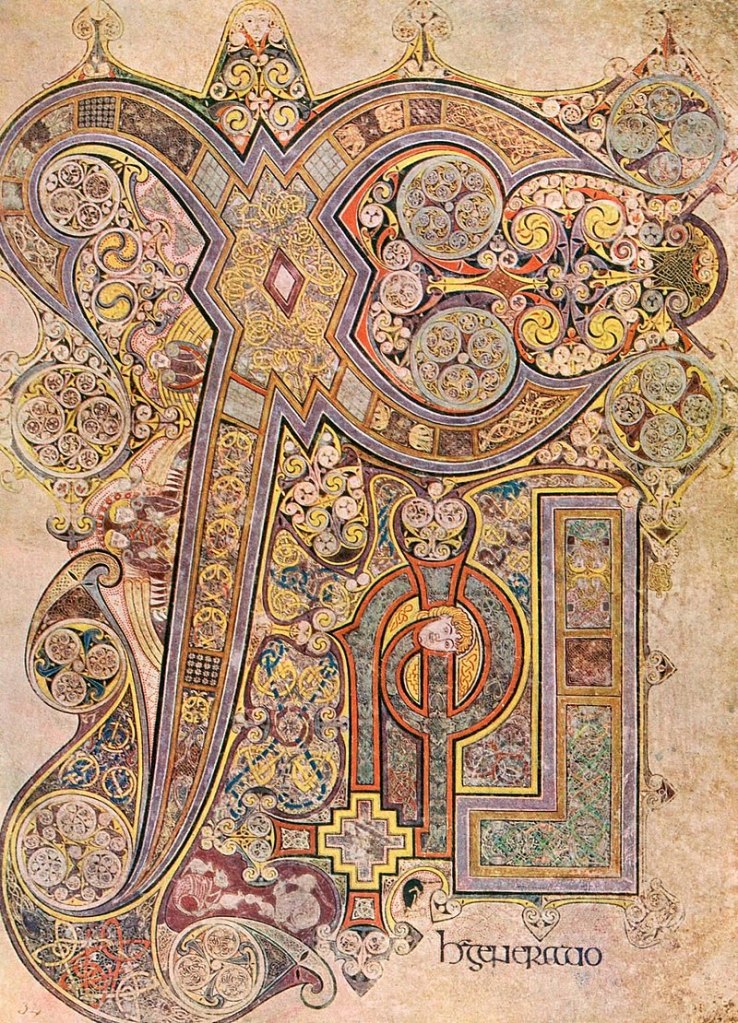
It’s the “seim anew” in visual form.
Of particular importance to Joyce is the “Tunc page,” which I.5 suggests was inspired by the Letter. This page in the Book of Kells is dedicated to the sentence “Tunc crucifixant cum eo duo latrones” (“Then they crucified two thieves with him”). The word TUNC is huge and dominates the page:

This sentence is of importance to the Wake, as HCE’s Fall in the Park is compared to Christ’s passion (his “three and a hellof hours’ agony of silence,” I.4).
The X at the bottom of the Tunc Page recalls the cross. There are three boxes surrounding it, like the three soldiers who destroy HCE (“there are exactly three squads of candidates for the crucian rose,” I.5). The five faces in each box form additional Xs. Joyce refers to all of the Xs — the big one at the bottom and the three boxes — as four kisses on the page.
Kiss (“poghue” in Irish) is important in the Wake, for reasons I’ll get into in another post. It’s said to be a “key.” The next-to-last sentences of Finnegans Wake are “Lps. The keys to. Given!” The keys two. Given, as the final sentence clarifies, “A way” [away]. But also given to whoever asks (“ask, and it shall be given”).
A kiss is also a key element of the brother battle in I.4, which ends with reconciliation by means of a poghue puxy, a kiss with fists.
In Chapter I.1, Joyce describes ALP gathering up the pieces of the Fall, and he concludes the paragraph, “With Kiss. Kiss Criss. Cross Criss. Kiss Cross. Undo lives ’end. Slain.”
Those are the four crosses or kisses that sign ALP’s Letter and that adorn the Tunc Page, which is its analogue or dream symbol.
“Undo lives ‘end” balances with “Slain.”
But “undo lives ‘end” is both until life’s end and the undoing of life’s end (the resurrection).
And “Slain” is both death and (sounds like) an Irish word that’s used as a toast (and another Irish word that means “goodbye”).
In I.5, describing the Letter, the narrator observes the
cruciform postscript from which three basia or shorter and smaller oscula have been overcarefully scraped away, plainly inspiring the tenebrous Tunc page of the Book of Kells
This passage is saying that the postscript of the letter is in the shape of a cross (cruciform), which corresponds to the letters on the Tunc page being arranged in a big X (or cross or phallus).
The three other crosses (boxes with faces) correspond to the three “basia” (kisses) that the narrator says have been scraped off the Letter (leaving only the big cross on the Letter — but the original letter, with four crosses, was apparently the inspiration for the Tunc page).
He also calls the crosses “shorter and smaller oscula.” That’s the plural of “osculum,” the excretory structure in sponges.
There are some interesting bits that follow about those figures in the boxes — which seem to represent the five members of the dreamer’s family (father, mother, boys, and girl), along with their mythic, symbolic cognates (the masculine and feminine principles of the universe, the warring contraries of time and space, and sexuality/temptation). I shall perhaps address these bits in a future post.
The narrator concludes, regarding the last, large cross,
that last labiolingual basium might be read as a suavium if whoever the embracer then was wrote with a tongue in his (or perhaps her) cheek
I will leave interpretation of this quote up to the reader, with a reminder that throughout the Wake, Joyce unites the high and low, the profound and the dirty. Sometimes a crude joke can also be a key — “The keys to.” — Paradise. It all depends on how you view it, how you turn your eye toward the text and reality to read both.
 The Suspended Sentence
Pingback: Antechristian Crossing | The Suspended Sentence
Pingback: Shut Your Eyes and See | The Suspended Sentence
Pingback: Leafy Speaking, Part 2 | The Suspended Sentence
Pingback: Leafy Speaking, Part 3 | The Suspended Sentence
Pingback: Illysus Distilling | The Suspended Sentence