
This is a silly post that speculates (half seriously) that James Joyce is responsible for Star Wars.
Joseph Campbell famously argues that many of the world’s myths share so many commonalities that they can be considered versions of a single great story running through the human psyche throughout history, a story that he calls the “monomyth.” In The Hero with a Thousand Faces, Campbell articulates the idea of the monomyth (“the hero’s journey”), aspects of which are reflected in most of the majors stories of world mythology.
Campbell was influenced by Jung, who held that there is a collective or inherited dimension of the unconscious mind, one that contains symbols that we respond to and that we are impelled to use in our creative endeavors. Another way to put Campbell’s idea of the monomyth is that the various stories and legends told by humans throughout history tend to embody various aspects of the archetypal hero’s journey, refracted through the lens of the culture and time in which they are produced (and through the lens of the individual mind that thinks them up: myths, Campbell said, are the dreams of cultures, while the dreams of each individual are that person’s own myths).
The ideas of both Campbell and Jung have been criticized for a number reasons, which is beyond the scope of this post. Suffice it to say that many people find the above theories to be at least somewhat of an oversimplification. Yet there certainly are patterns and themes and images that are repeated throughout world mythology, even in cultures that had no prior contact with each other. It shouldn’t be controversial to affirm the basic idea that there is an inborn human tendency to create somewhat similar sorts of stories.
Joseph Campbell was also the co-author of A Skeleton Key to Finnegans Wake, the earliest attempt to explicate the novel page by page. Campbell in fact borrowed the word “monomyth” from Finnegans Wake, as he saw Joyce essentially trying to sum up all of world mythology and religion into a single text. And indeed, one can read Finnegans Wake as proposing that there exists an eternal story that repeats (with variations) in every generation. It wasn’t just Jung that influenced Campbell’s most famous idea: without Finnegans Wake, Campbell might not have formulated the monomyth in the way that he did (and he certainly wouldn’t have called it that).
The Hero with a Thousand Faces, Campbell’s popular treatment of his idea, influenced a young filmmaker named George Lucas, whose Star Wars was written to follow the beats of the archetypal hero’s journey.
This is the justification for my somewhat tongue-in-cheek claim that James Joyce is responsible for Star Wars. Or, at least, perhaps we could say that without him and his influence on The Hero with a Thousand Faces, it is possible that Star Wars would have been considerably different.
I’ve long wondered if George Lucas was familiar at all with Finnegans Wake. As someone interested in Joseph Campbell’s work, he may well have read some Joyce and perhaps at least dabbled in the Wake.
I’ve wondered, for instance, whether Obi-wan’s description of Darth Vader as “more machine than man” was influenced by Joyce’s description of HCE as “more mob than man” in II.2.
There’s also the word “hoth” on page 4, which is the name of a planet in The Empire Strikes Back.
Additionally, there is a word in I.7 that sounds like Dagobah, the swampy planet of Yoda’s exile. Describing the police officer who is a Shaun character, the narrator says,
big the dog the dig the bog the bagger the dugger the begadag degabug
Here, I like how the word “big” (which is what Shaun thinks of himself, the extrovert aspect of the dreamer) transforms into “beg” (the begger/Cad in the Park). The brothers dwell within each other.
There’s also this line:
My chart shines high where the blue milk’s upset.
Could this be the inspiration for the blue milk the characters are drinking in the original Star Wars film?!
Nah, this is obviously all very silly. It’s not surprising that a long text full of made up words has some words that coincidentally sound sort of like made up planet names in a piece of popular fiction. And “more mob than man” probably descends from “more mouse than man” (as in “Are you man or mouse?”).
But still, it’s fun to consider whether any Wakese was rolling around in George Lucas’ head.
[In preparing this post, I also found the word “Naboo,” a planet from the execrable prequel films, embedded in a word on page 54: “Downaboo,” which plays on an Irish phrase meaning “Down to Victory”; Naboo, viewers of The Phantom Menace will recall, won an apparent victory in a scenario that was actually a step in a galactic supervillain’s evil plan….]
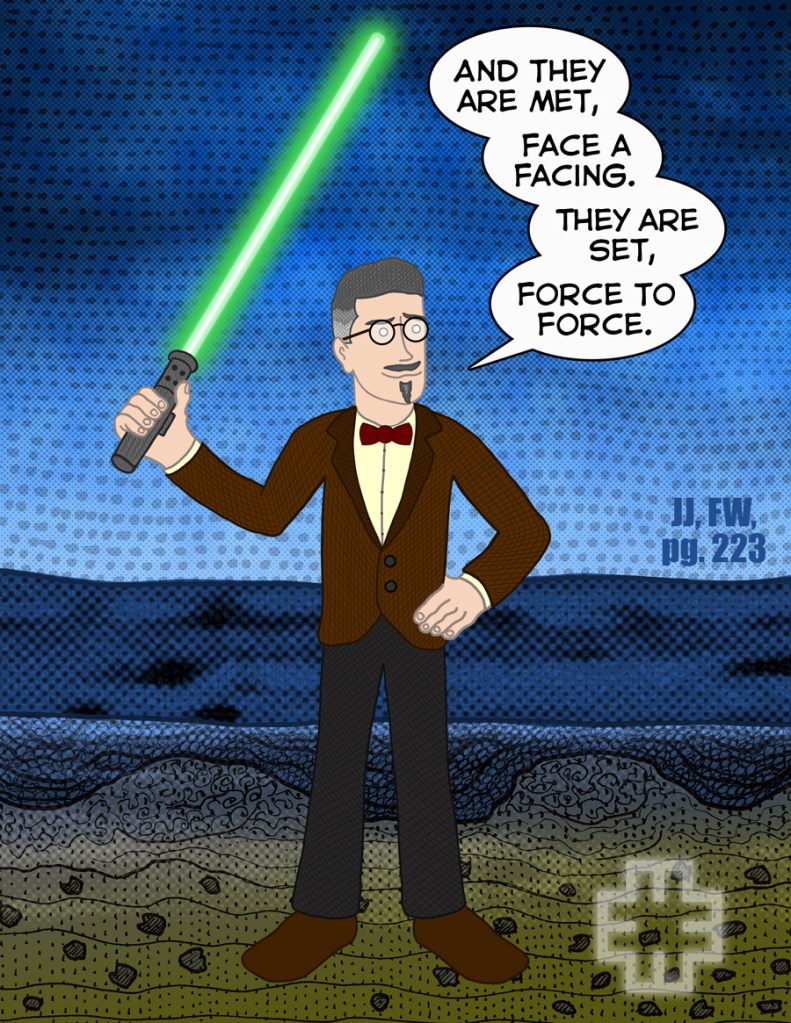
I don’t think very much has been written about this topic – mostly because it’s pure speculation and silliness – but I did come across a blog post that proposes Finnegans Wake is an influence on Star Wars. You can read it here. While the connections drawn in that post are rather superficial, I very much enjoyed its cartoon of James Joyce holding a lightsaber, delivering a great line from his enigmatic final novel.


Pingback: James Joyce Anticipated Breaking Bad | The Suspended Sentence
Not to mention that the wake was published on may 4th, which is, of course, Star Wars day.
may the fourth be with you;)
LikeLike
Good catch! Thank you.
The evidence is piling up….
LikeLike
Pingback: What Makes Finnegans Wake Great? | The Suspended Sentence