
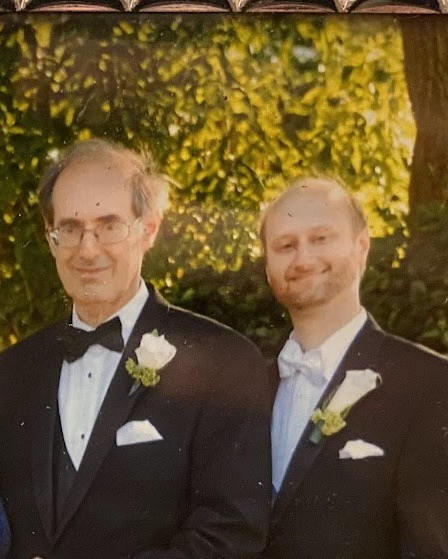
My dad died last week.
I’ve been thinking of life and death in terms of Finnegans Wake and its exploration of fatherhood. Read on for a few brief thoughts on this subject, intermixed with a memorial for my own father.
At the end of the Wake, the female aspect of the dreamer speaks to her sleeping/dead husband, who is soon to rise, and she remarks how their two sons resemble him: “When one of him sighs or one of him cries ’tis you all over.”
I’ll never forget the time, long ago now, when an in-law of mine met my father for the first time. She exclaimed to me afterward, “Wow, your dad is exactly like you!” She had in mind many things: our mannerisms, general appearance, various cadences of speech, phrases we both used. However, the truth is not that he was like me but rather that I’m a version of him: I’ve inherited and learned various habits and behaviors that make me reiterate him in the world in new ways.
I’m reminded of a passage in Finnegans Wake II.2, where it says that two characters with similar names have “not a feature alike and the face the same,” and that this kind of similarity is the way it’s been since “primal made alter in garden of Idem.” Punning on the phrase “Garden of Eden” — “Idem” is Latin for “same” — Joyce suggests that since the beginning of time, the primal forces of the universe have taken the same material and altered it into new shapes, the same basic patterns repeating with variations, just as the same general face (and mannerisms) can be passed down through a family over the generations with modified features.
And not just inherited traits and unconscious tics — learned values and mental habits. People have noted that my father shared the same kind of enthusiasm and passion I have, just directed at different subjects. I’ll say more on this topic below, and especially about the great influence my father had on my intellectual curiosity, but here I want to recall how much he loved history and how he would especially read up on the history of places we visited as a family.
When I was a child, we took many vacations along the East Coast. My dad would schedule business trips in the summer, when my brother and I were off from school, so he could bring his family along. We saw many historical locations, and very often my dad would banter with the tour guides there, asking insightful questions that showed he knew a fair amount. He would typically impress the guides, and sometimes he knew more than they did (especially if they were largely disinterested teens working a summer job). Sometimes he’d ask questions that would stump them. And it wasn’t done for the purpose of showing off — it wasn’t “smartest-guy-in-the-room syndrome,” where he felt a need to prove himself. He was legitimately and authentically interested, excited, and curious.
Once, we went to the United First Parish Church in Quincy, MA where John Adams and his son had been parishoners. This is not a famous tourist location at all, or at least that’s not my recollection of it. I just now looked it up and apparently it’s known as the “Church of the Presidents,” so I guess people do go there. My dad had read about it, and we visited during a trip to Boston. We arrived there pretty late in the evening, and no other tourists were around, and my dad struck up a conversation with someone who worked there — my memory is that it was a custodial worker, but I cannot be sure of that — and as he was excitedly talking about all he knew about the history of the church and asking questions, it became clear that the guy was impressed by my dad’s knowledge and passion for the history. So the guy took us down to the basement of the church to see something we didn’t expect to see: four sarcophagi that held the remains of John Adams, John Quincy Adams, and their wives. We had no idea they were there until that moment. That was a cool memory.
I have a lot of memories of seeing all sorts of interesting places with my dad. In thinking of his travels and interactions with others and his impact on his family, I think about that line from Tennyson, “I am a part of all that I have met,” the idea that we leave behind our influence and become connected to everywhere we go and everyone we meet on our travels. And I think of one of the conceits of Finnegans Wake, that the fallen dreamer becomes the very landscape of the dream, that the fallen body of Finnegan/HCE becomes one with the universe, a stage on which the future plays out. Simultaneously, he becomes a platter of food to nourish the next generations, like the many dying gods throughout world mythology who give rise to crops and communion feasts.
The past is no longer here, but it does not leave us.
*
One of the main ideas of Finnegans Wake is that the dead do not die and the past is never fully gone. At first glance, those ideas might sound like an absurd exercise in wishful thinking at best.
But a theme of many writings about death is that it isn’t ultimately real, and that the person being mourned is not truly dead. Probably the most famous example is John Donne’s sonnet “Death Be Not Proud,” which takes as its inspiration the religious belief in Christ’s victory over the grave: “Death, thou shalt die.”
That’s all well and good for the religious, but a non-religious person like myself doesn’t have a literal belief in an afterlife to appeal to. What I have instead is the knowledge that everything that made up my father, every molecule of his being that made him all that he was, came from the material world around us. And every last one of those molecules will go back into the world. This isn’t a statement of faith: it’s what we know happens.
That is why I chose the poem “Do Not Stand at My Grave and Weep” by Clare Harner to print on his memorial cards:
Do not stand at my grave and weep;
I am not there. I do not sleep.
I am a thousand winds that blow.
I am the diamond glints on snow.
I am the sunlight on ripened grain.
I am the gentle autumn rain.
When you awaken in the morning’s hush
I am the swift uplifting rush
Of quiet birds in circled flight.
I am the soft stars that shine at night.
Do not stand at my grave and cry;
I am not there. I did not die.
Again, it’s not poetry or symbolism to say that my father is joining the universe around us, that molecules that were once part of his body will continue on as part of other aspects of the world, that molecules of air that passed through his lungs are also passing through mine and the lungs of all other breathing creatures, etc.
It’s also not merely symbolic to say that seeing the sights of the universe — especially things I connect with him, including things that he and I saw on walks together at nature preserves, the trees that he loved so much, the stars and planets we’d look for together, the wild creatures he enjoyed watching — bring my father to my mind and make me experience him again. The same is true when I encounter his intellectual interests.
And this is precisely what Finnegans Wake is about: the past lives on in us. The Wake suggests that people live on not only in the universe around us (and the recurring kinds of experiences of humanity in which we all participate) but in the deeds of their descendants and friends, and especially in stories told about them.
After all, what is a person, asks Finnegans Wake, but a story — or, rather, a collection of stories that can be told and retold and exaggerated and transformed…ultimately into a kind of personal mythology that can influence the way we live?
Allow me to wax philosophical for a moment. A person cannot merely be the molecules that make him up, because those are constantly in flux (if I am nothing more than these current molecules, then I won’t exist by the time I finish writing this sentence because those molecules will have somewhat changed in the time it took to write). But, at the same time, we have reason to doubt that there is any kind of permanent essence that exists and endures beyond those physical fluctuations.
What people are, at least in one important sense of that word, are their deeds, their impact on the world around them, and the impressions that they make on the minds of other people.
I carry with me certain ideas of my father, various stories, which I sharpen up and polish and develop by telling those stories over and over — to others, to myself. Other people have such stories/impressions about him too, and my dad had his own stories and ideas about himself, some of which he shared out loud and all of which influenced to some degree his behavior.
What is a man, at the end of the day? He’s not the shifting molecules that constantly changed during his life — and he’s certainly not the still-shifting collection of molecules that we put in the ground the other day — and he’s not a supernatural essence that we have no good reason to believe in.
He is what he always was: a series of stories and ideas and feelings in the minds of people who knew him.
I feel like it would be easy for a reader to dismiss what I’m saying here as a platitude or some symbolic delusion to compensate for death. But in fact, I’m actually advancing an evidence-based, and fairly revolutionary, way of thinking about existence: my father lives on in our minds and in the universe in the same exact way that he always, even when he was alive, existed in our minds and in the universe.
And every last one of us, even me right now, exists in that same way. There are no firm boundaries between my body and the world around me. Molecules are passing in and out of me and changing. I’m made up of all different material than I was a decade ago. In many ways I’m a different person than I was a decade ago (for one, I wasn’t blogging about Finnegans Wake back then….).
There’s a bunch of constantly changing molecules that can right now be described as “me sitting in this chair writing this post.” But what am I? I’m intermixed with the universe. I exist as my impact on the world, and as stories and ideas in my mind and in the minds of everyone I know. The universe, and those stories, will endure.
I’m as unkillable as Tim Finnegan.
*
Finnegans Wake takes its inspiration from a silly Irish vaudeville song of the same name, in which a construction worker drunkenly falls off a ladder and dies. At his wake, a drunken brawl breaks out, and a bottle of whiskey spills on the corpse. The word for whiskey in Irish means “water of life,” and indeed this liquor revives the body.
“Soul of the devil, did you think I’m dead??!” cries Finnegan, rising from the coffin and joining the party.
Joyce takes this funny little song and turns it into an allegory for the Fall and Redemption of Humanity.
Finnegans Wake is supposed to represent a dream, and the dreaming body in bed is analogous to a dead body, which is analogous to each one of us wandering through life in a “fallen,” egotistical mental state. The waking of the dreamer is analogous to the resurrection of the dead, which is analogous to each one of us “rising” into a more enlightened perspective and behavior.
The dreamer becomes not only Tim Finnegan but a man with the initials HCE, which stand for, among other things, Here Comes Everybody. The Wake is supposed to be the story of humanity, the story of each of us: the story of falls into transgression and selfishness and rises into forgiveness and community.
Like Finnegan, HCE is unkillable. He dies and is resurrected — but he does so continually and cyclically. The Wake imagines the universe as a cycle, where each generation is replaced by the next to act out its patterns of fall and rise again, in somewhat different ways each time.
So one way to read this is to take HCE not to be a specific person but a type of person, an Everyman. He “rises” in the sense that his story is played out in each generation, with new actors in different ways, but the same old story anew. Hence, he is Tim Finnegan, but he is also everyone from mythology, literature, history, and contemporary everyday life. He is Napoleon, Wellington, Charles Stuart Parnell, Adam, Christ, the Devil, Osiris, Humpty Dumpty, and each and every one of us — and that’s just for starters!
He is all stories, including all stories we have of ourselves and our loved ones, and he endures through the telling and retelling and developing of those stories.
In Finnegans Wake II.3, the sons of HCE speak of the Fallen Father as they toast:
We rescue thee, O Baass, from the damp earth and honour thee. O Connibell, with mouth burial!
Bass and O’Connell are brands of beer. The sentence suggests raising the dead HCE (the great Boss) from the earth and burying him again in a way that involves drinking and eating: the drinkers call him a cannibal (“Connibell”) — just as he, in a past cycle, devoured his own fallen father, he has now become a meal for the next generation. His sons reiterate his behavior and themselves become cannibals, taking communion by consuming this god (the phrase “mouth burial” apparently comes from a book about cannibal cultures, as do other phrases in sentences surrounding this one).
The kind of “mouth burial” that comes to my mind is storytelling. Through the stories we tell of the deceased, we sum up their lives and solidify our ideas of them in our minds, burying them, and we bring them back to life by keeping the stories in circulation, to continue to develop and transform, exactly as they did in the deceased’s life. And just as the dying gods in history are reborn as food — Christ as communion, Osiris as crops, HCE as the feast at his wake — the dead return as stories to sustain us and nourish not only our memories of them but our own sense of ourselves.
*
A eulogy is a perfect example of this kind of storytelling, and I was honored to be able to eulogize my father at his wake. Here, I’m going to go on at some length about my dad, and I will be more self-indulgent than I usually am on this blog. I make no apologies for this. Skip to the next section if you want more Finnegans Wake analysis.
I spoke first and foremost of his unconditional love for his family and his willingness to do anything to support them. I was lucky to grow up with a father who was not emotionally distant, unapproachable, or absent, as so many fathers apparently are: he was a wellspring of warm affection.
Here’s a story: when I was in second grade, he dropped me off at some school event and then waved at me and blew a kiss as he left. Some dipshit kid turned to me and said, “You kiss your dad??” as if it were some kind of horrific crime. [I’m reminded of Stephen Dedalus in Portrait being teased both for saying he kissed his mother and for saying he didn’t kiss his mother]
I remember thinking how sad it was that this kid didn’t have a father who showed him affection. In hindsight, it really explains a lot about the world that so many people grow up without a sense of unconditional love from their fathers.
But it wasn’t just words and tokens of love and affection: it was action and sacrifice. Not only did my father spend years waking at 4 AM every morning to beat traffic into work to earn a living for his family, he always — without hesitation — did anything for us that we needed. He’d pick me and my brother up from high school when we stayed late for clubs (sometimes waiting outside the school for hours); he drove us anywhere we needed; he gave up entire Saturdays often to act as a judge at high school debate events.
He made sacrifice after sacrifice for his family, and he did it all without complaint. Never once did he frame it as an imposition, or something he’s doing grudgingly. “This is just what I do,” he’d say. I owe him so much, but he would never, ever frame it as debt. He gave me literally everything he had, and he never asked for or expected a single thing in return.
As a result, I felt an incredible sense of security throughout my life, like I always had someone in my corner, willing to do anything for me, and I could never lose his love and support no matter what I did. At the eulogy, I joked that if I had ever killed someone, my father would have helped cover it up and would have tried to go to prison for me. That really wasn’t a joke. I honestly felt like that is what he’d do. And knowing he’d put himself out like that for me, I tried to live my life in a way that he wouldn’t have to put himself out more than he already had. I will always be grateful for the way he made me feel.
Over and beyond that, I also am thankful for the way my dad helped cultivate my intellectual curiosity. He was always interested in science and always talking to me about human knowledge and discoveries. Even from an early age, he would tell me that, basically, science was the best thing humanity ever did…humans are essentially a bunch of apes who arose on a spinning rock in the middle of nowhere…but look what we’ve discovered. We’ve managed to learn so much about the universe, construct amazing technology, and even travel off the planet!
He introduced me to Carl Sagan’s work, and the scientific optimism he represents: science is a “candle in the dark,” an opportunity — our only opportunity — to leave behind superstition, mythology, religion, and magical thinking to embrace reality and improve the world. He helped me to understand that religion is not literally true — I believe his phrasing was that it’s a “load of bullshit” — but he also helped me to recognize its cultural importance, and he introduced me to the writings of Joseph Campbell, who showed me that the symbols of all world myths/religion can have meaning despite the fact that their stories didn’t actually happen and the supernatural elements don’t actually exist.
That word “bullshit” was one of my dad’s favorite words. “It’s all bullshit” was one of his most commonly used phrases, a slogan of sorts. I learned from him a realistic outlook on the world that could be reasonably suspicious in practical ways (“No one will ever contact you with something good for you…it’s always a scam,” which I think of every time “Scam Likely” gives me a call) and appropriately skeptical of absurdities (he loved the Amazing Randi, and turned me on to works of skeptical inquiry).
He was funny. He mocked all figures of authority in my presence and speculated (too often correctly) that they were mostly deviants and degenerates. Some fathers teach their children unwavering respect for authority, but it is generally weak men who have to promote such sycophancy. I learned no such thing from my father. There were no sacred cows to him. I learned from him the importance of doubt and the necessity to look skeptically at anyone who fancies themselves an “authority.” I learned disrespect for authority, in fact, contempt for those who would try to set themselves up in positions of power and try to constrain the individual person — qualities that would make writers like Joyce and Nietzsche appealing to me, along with comedic thinkers George Carlin.
He didn’t think anyone was worthy of respect merely based on reputation. When I told him that James Joyce once cheekily said, “The only thing I ask of my reader is that he study my works every day,” my dad scoffed and equally cheekily pretended to address Joyce as he held up his middle finger: “Yeah, okay, study this, buddy.” He refused to put anyone on a pedestal. The supposed great people of history and the arts are, as my dad would put it, “just a bunch of humps”; they are just as human as everyone else and no better.
What a liberating and important attitude he gave me! I grew up unencumbered by the idea that I have to follow some tradition or authority or arbitrary, abstract set of rules. Certainly he never expected me to follow in his footsteps. He worked as a civil engineer, and he did well at his profession, but he told me he just sort of fell into it because he was good at math in school. “Don’t be an engineer. Find something you like to do and do that,” he told me. He was perceptive enough to see that I liked words and stories, and he encouraged me as I entered college and majored first in journalism and then eventually English literature. He supported me monetarily all throughout my PhD studies and my first faltering forays into the atrocious academic job market, where almost no jobs are available. “Keep at it,” he would tell me, always assuring me that I would have his support. He agreed with Joseph Campbell’s motto for a good life: Follow your bliss.
He was a voracious reader, and he retired young enough to be able to spend his days reading things that interested him. He would follow any subjects that caught his fancy and read extensively about them. He watched movies and television shows and discussed them insightfully with me.
I still remember watching the film Amadeus with him, and hearing him discuss afterward how interesting he found the depiction of reading sheet music. And what did I see him reading the next day? A book called Teach Yourself Piano — he held the book in one hand as he fingered in the air with the other. And that was the beginning of him teaching himself to play piano in retirement. He was entirely self-taught, and he sounded great.
He was one of the most tolerant and open-minded people I ever met. When I was quite young, he told me explicitly that sexuality is a spectrum. I think he put it, “Everyone is sort of bisexual, to greater or lesser degrees.” When I was taking sex education in elementary school and said something about masturbation, he just shrugged and said, “Well, everyone does it.” I never knew him to harbor any racial animus. He never begrudged poor people the pittance that social support programs provide, and he thought that government could do more to improve the lives of citizens. He favored progressive tax structures that would require people who benefitted the most financially from this country to contribute a properly fair share. His politics were exactly what you would expect: nothing was more anathema to his nature than the self-centered attitudes of much of the modern conservative movement. In the 00s, he railed against the administration of George Bush II — I remember his impassioned opposition to the destructive tax cuts for Bush’s rich buddies and the abominable war in Iraq — and he supported Obama but was disappointed at how centrist his policies turned out to be. He was heartbroken at the disastrous and absurd current administration and far, far more disappointed at what the most recent presidential election says about the intelligence and values of a great deal of Americans.
He is the inspiration of my entire intellectual life. The value he placed on studying what is interesting and pursuing what is true inspires me to this day.
He never read Finnegans Wake, and I know he thought it was a bunch of “crazy bullshit” written by Joyce “when he was drunk” — sort of true — but I’d like to think that I explore this text with the same kind of intensity, interest, and passion with which he explored subjects that captivated him.
Oh, and let me return to how funny my dad was. He constantly had people who knew him in stitches with his sense of humor. His amusingly dismissive summary of some of Joyce’s writings cracked me up (The Dead: “Eh, this guy’s horny for his wife and she’s thinking about something else…so what?”). In my younger days, he and I watched together the old sitcom Married…with Children, which was aired back then multiple times a day in syndication. He would tape each day’s episodes so that we could watch them that evening with dinner.
I realize, of course, this show has a reputation of being crass and not particularly elevated, and that it suggests to some people a regressive or misogynistic view of the world. That impression of the show is actually largely mistaken. Having watched every episode of Married…with Children with my father multiple times — in some cases, we saw certain episodes dozens of times over the years — I can testify to the fact that there is a surprising and impressive amount of clever and sometimes layered joke writing and performance, and that the show for the most part makes fun of regression and misogyny. And yes, it contains crudity and toilet humor…but so do Ulysses and Finnegans Wake.
We would quote the show to each other daily. After he learned how to send text messages, he would text me quotes periodically while I was out, and after I moved out of the house, he would text me quotes every single night. I credit my dad for my love of quotations. Ultimately, this enthusiasm for quoting is responsible for my love of Finnegans Wake, which is, in one sense, a love letter to the process of citing and re-citing and circulating discourse, as words and phrases repeat throughout the novel. I said to him at the end of his life: what is my career, after all, but a process of quoting and analyzing literary texts, teaching students to quote and use quotations to support arguments?
I said at his wake that I, my brother, and my daughter are his legacy in this world. We are his “values made manifest.” Finnegans Wake shows us how we all constantly carry the past into the present.
*
One of the main struggles of Finnegans Wake is Oedipal. The sons of HCE, especially in their combined form as the “Cad in the Park,” seek to overthrow their father and take his place. Conquered, condemned, and destroyed, HCE is split into the two sides of his personality, his sons Shem and Shaun. These two lesser versions of HCE battle each other and ultimately reconcile into a new being, a new HCE who will start the cycle anew. And though their combined form is indeed new, it is a new variation on the old, something self-similar in a new guise.
Let me return to the end of the novel, when ALP talks to the sleeping/dead HCE about their children:
The childher are still fast. There is no school today. Them boys is so contrairy. The Head does be worrying himself. Heel trouble and heal travel. Galliver and Gellover. Unless they changes by mistake. I seen the likes in the twinngling of an aye. Som. So oft. Sim. Time after time. The sehm asnuh. Two bredder as doffered as nors in soun. When one of him sighs or one of him cries ’tis you all over. No peace at all.
This whole little bit is extraordinary, identifying the brothers with the contrary forces of the universe, the yin and yang (and contrairy because they are the twins, Gemini, a zodiac sign attributed to air). The sentences are filled with doublings: the brothers are the head and heel of the human body; two variant spellings and versions of the traveling Gulliver from Swift’s famous novel; they are Som and Sim (“Som” is Danish for “like” and “Sim” suggests “similar,” and they are variants of Tom and Tim, names for the brothers that appear throughout the Wake); and they are noise and sound (“nors in soun”).
But at the same time, the brothers are distant echoes of an original greatness. If they are noise and sound, HCE is the meaning expressed through them; if they are Galliver and Gellover, HCE is the original Gulliver. If they are heel and head, then HCE is the full human body. Etc.
I’ve written elsewhere about how the brothers each have a different weapon/tool, each representing his particular partial understanding humanity; how they each embody a different and limited philosophical attitude. HCE represents the synthesis of these understandings.
In our own lives, each of us tends to gravitate toward a more Shemish or Shaunish perspective, and it can help us develop as people to identify those tendencies and try to cultivate the contrary perspective a little more, and synthesize all of these ideas into a broader view.
I tend toward a Shemish perspective. As a child, I was often bookish and introverted, more interested in the imagination than in the reality I share with other people. My father encouraged my natural pursuits, but he also urged me to develop more Shaunish attributes. He showed me maps so that I could learn where I am, spatially, in the world. He taught me about politics, economics, and other subjects I associate with Shaun. He helped me to get around and navigate the world in practical ways. I’ve tried to incorporate all of his best qualities and also moderate the few less helpful aspects of his personality that I find in me.
The father lives on through the sons, and the sons find a model of development in the father. And on turns the wheel of generations, presenting the “same anew” in ever-varying forms.
Or, as my dad liked to say, quoting one of our favorite shows, The Sopranos, “On it goes, this thing of ours.”
Love you, Daddy. Thanks for everything.
 The Suspended Sentence