
I’m back from the first trip to Dublin I’ve taken in my life. It was a marvelous experience: this blog’s editor and I spent a weekend visiting Joycean sites, some obvious (Sweny’s pharmacy and Davy Byrne’s from Ulysses) and some more obscure (the Magazine Fort in Phoenix Park where Mr. Duffy stands at the end of “A Painful Case” and the corner of Hume street where the girl from “Two Gallants” waits). At many locations, I read quotations from Finnegans Wake, Ulysses, and Dubliners. If you’ll forgive some flowery language, I later described this process as akin to casting magic spells around Dublin, “binding” my consciousness to those locations and to the city as a whole.
Read on to see some pictures and quotes!
We were staying right near Chapelizod, where the dreamer of Finnegans Wake is thought to live in “real life.” [“Chapelizod” comes from “Chapel of Isolde,” which connects to the Tristan and Isolde legend that is so important to the Wake] Every time we traveled into the city center, we passed Phoenix Park and the Wellington Monument.
The first day, we visited the Park, the Garden of Eden of Finnegans Wake, the site of HCE’s unnamed offense. We went right up to the Monument and even climbed up the steps to touch it.

Hence when the clouds roll by, jamey, a proudseye view is enjoyable of our mounding’s mass, now Wallinstone national museum, with, in some greenish distance
[…]
This the way to the museyroom.
We also found the Magazine Fort, where Finnegan/HCE fell:
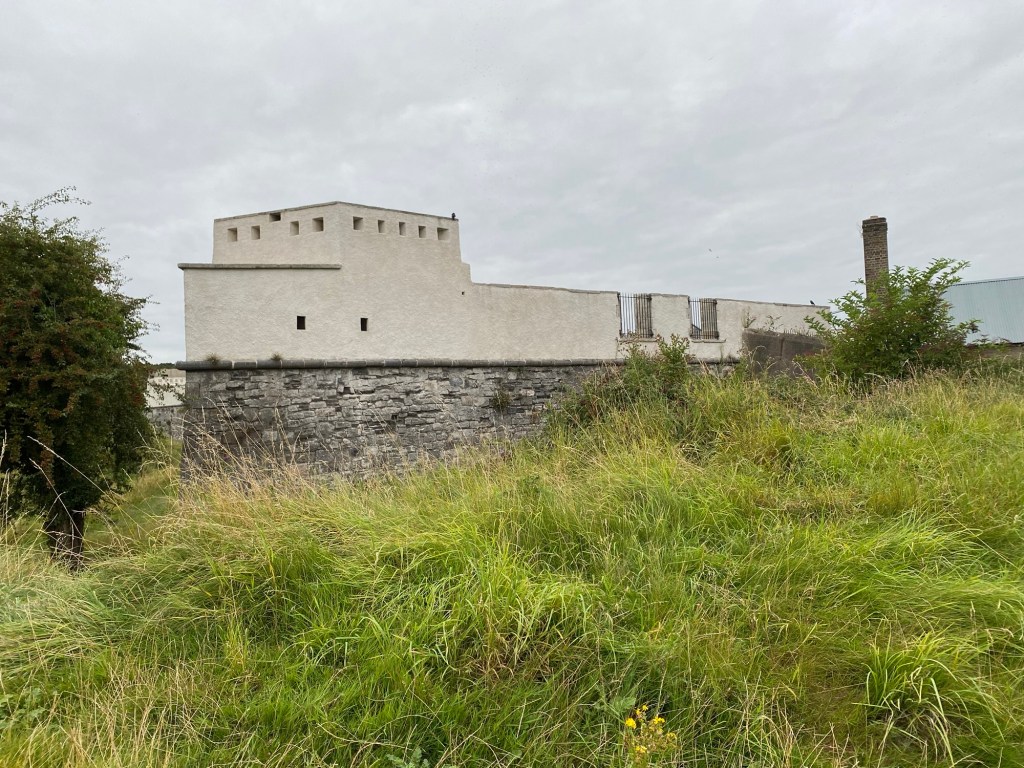
by the mund of the magazine wall, where our maggy seen all, with her sisterin shawl.
[…]
Have you heard of one Humpty Dumpty
How he fell with a roll and a rumble
And curled up like Lord Olofa Crumple
By the butt of the Magazine Wall,
(Chorus) Of the Magazine Wall,
Hump, helmet and all?
This is also the place where Mr. Duffy stands at the end of “A Painful Case,” and here’s the view of Dublin he has at the end. I assume that in the fall and winter it’s easier to see the city and river, as he does in the story:
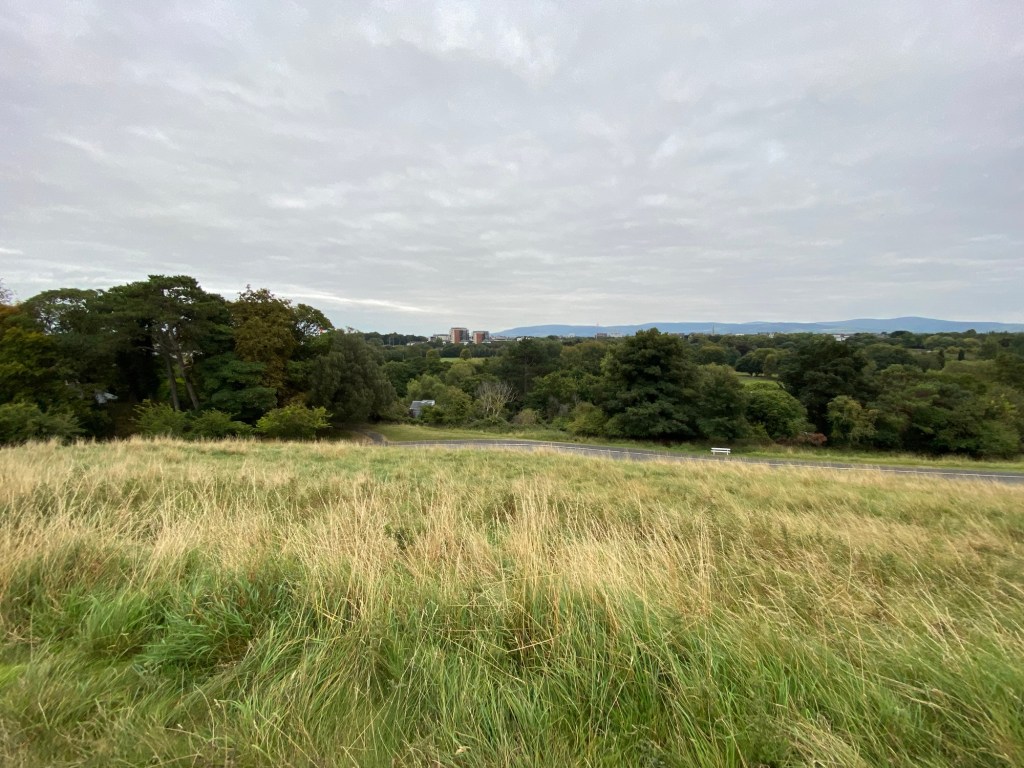
When he gained the crest of the Magazine Hill he halted and looked along the river towards Dublin, the lights of which burned redly and hospitably in the cold night. He looked down the slope and, at the base, in the shadow of the wall of the Park, he saw some human figures lying. Those venal and furtive loves filled him with despair. He gnawed the rectitude of his life; he felt that he had been outcast from life’s feast. One human being had seemed to love him and he had denied her life and happiness: he had sentenced her to ignominy, a death of shame. He knew that the prostrate creatures down by the wall were watching him and wished him gone. No one wanted him; he was outcast from life’s feast. He turned his eyes to the grey gleaming river, winding along towards Dublin. Beyond the river he saw a goods train winding out of Kingsbridge Station, like a worm with a fiery head winding through the darkness, obstinately and laboriously. It passed slowly out of sight; but still he heard in his ears the laborious drone of the engine reiterating the syllables of her name.
We also saw the statue of Anna Liffey:

O
tell me all about
Anna Livia! I want to hear all
about Anna Livia. Well, you know Anna Livia? Yes, of course, we all know Anna Livia. Tell me all. Tell me now. You’ll die when you hear. Well, you know, when the old cheb went futt and did what you know. Yes, I know, go on. Wash quit and don’t be dabbling. Tuck up your sleeves and loosen your talktapes. And don’t butt me—hike!—when you bend. Or whatever it was they threed to make out he thried to two in the Fiendish park.[…]
In the name of Annah the Allmaziful, the Everliving, the Bringer of Plurabilities, haloed be her eve, her singtime sung, her rill be run, unhemmed as it is uneven!
And we saw the Liffey River itself, including its famous mud:
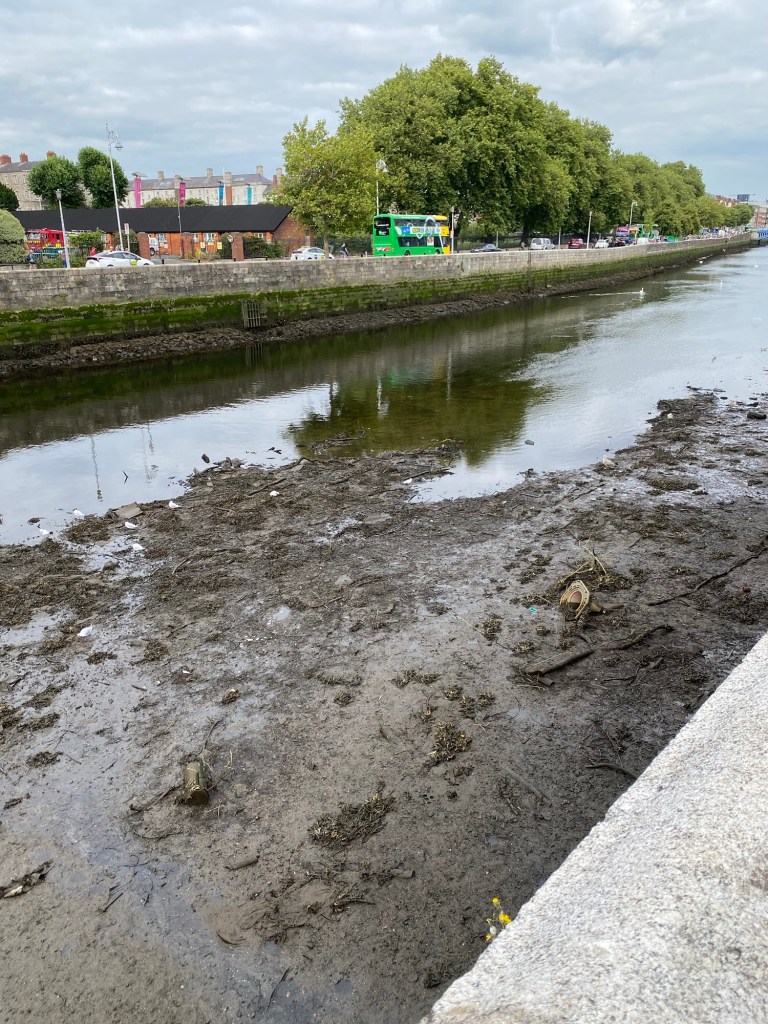
The lads is attending school nessans regular, sir, spelling beesknees with hathatansy and turning out tables by mudapplication.

Come all ye goatfathers and groanmothers, come all ye markmakers and piledrivers, come all ye laboursaving devisers and chargeleyden dividends, firefinders, waterworkers, deeply condeal with him! All that is still life with death inyeborn, all verbumsaps yet bound to be, to do and to suffer, every creature, everywhere, if you please, kindly feel for her! While the dapplegray dawn drags nearing nigh for to wake all droners that drowse in Dublin.
One of the bridges over the Liffey has been named the James Joyce bridge, but I didn’t take a picture of it, so you’ll just have to imagine it.
We also saw the pub “Nancy Hands,” which is mentioned in Finnegans Wake; however, the modern restaurant is not the one Joyce was referring to: the original changed its name and is some distance away (far enough that we didn’t want to walk there just to say we had seen it).

Haha! Huzoor, where’s he? At house, to’s pitty. With Nancy Hands. Tcheetchee!
[…]
So sailed the stout ship Nansy Hans. From Liff away. For Nattenlaender. As who has come returns. Farvel, farerne! Goodbark, goodbye!
Now follow we out by Starloe!
Irish stew for dinner at the Brazen Head, supposedly the oldest pub in Ireland:
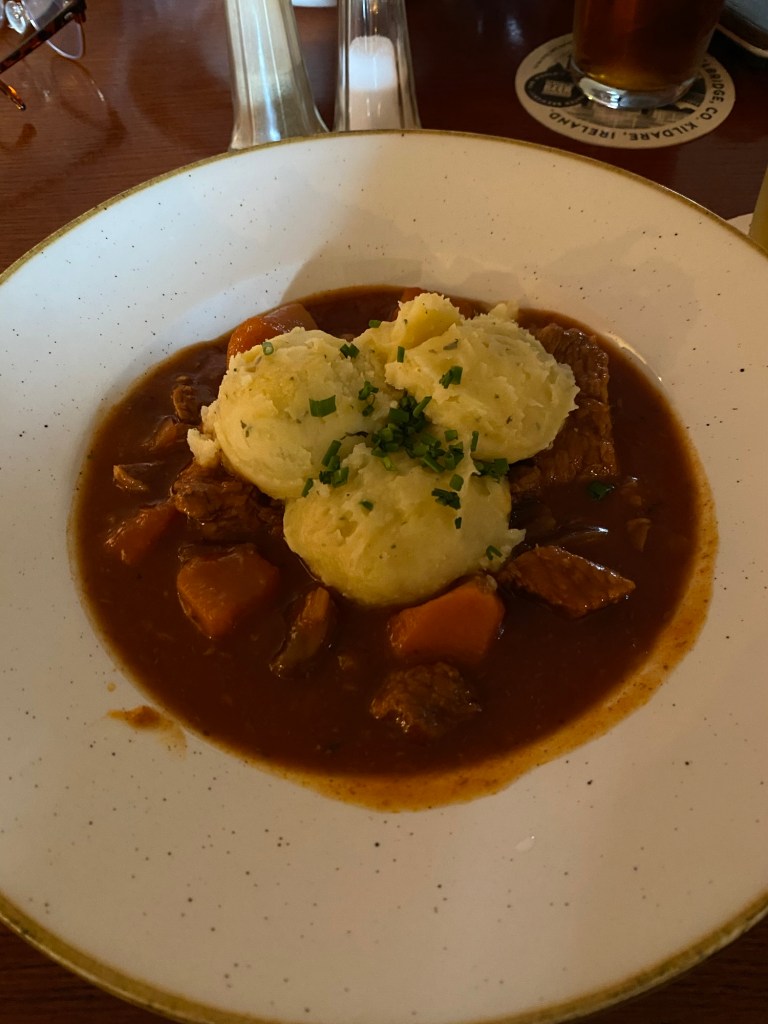
Sniffer of carrion, premature gravedigger, seeker of the nest of evil in the bosom of a good word, you, who sleep at our vigil and fast for our feast, you with your dislocated reason, have cutely foretold, a jophet in your own absence, by blind poring upon your many scalds and burns and blisters, impetiginous sore and pustules, by the auspices of that raven cloud, your shade, and by the auguries of rooks in parlament, death with every disaster, the dynamitisation of colleagues, the reducing of records to ashes, the levelling of all customs by blazes, the return of a lot of sweetempered gunpowdered didst unto dudst but it never stphruck your mudhead’s obtundity (O hell, here comes our funeral! O pest, I’ll miss the post!) that the more carrots you chop, the more turnips you slit, the more murphies you peel, the more onions you cry over, the more bullbeef you butch, the more mutton you crackerhack, the more potherbs you pound, the fiercer the fire and the longer your spoon and the harder you gruel with more grease to your elbow the merrier fumes your new Irish stew.
The next day, we saw Trinity College:

Latin me that, my trinity scholard, out of eure sanscreed into oure eryan!
We walked the path that Lenehan does in “Two Gallants,” including spying the corner on which Corley met the girl:
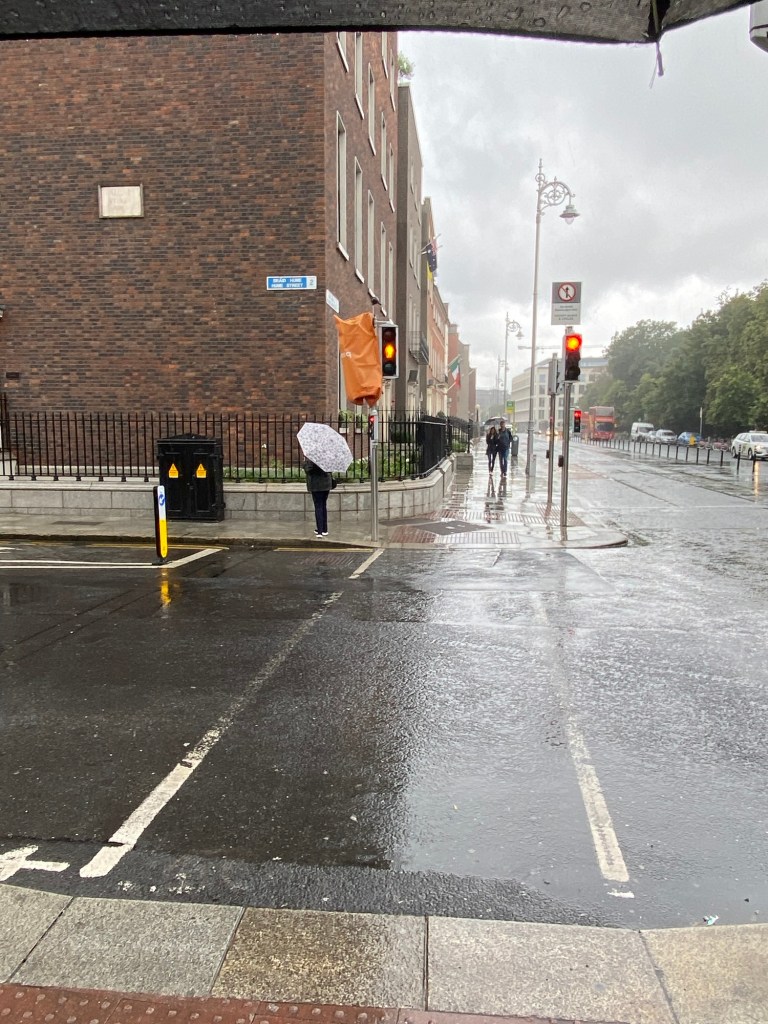
At the corner of Hume Street a young woman was standing. She wore a blue dress and a white sailor hat. She stood on the curbstone, swinging a sunshade in one hand.
[…]
As he approached Hume Street corner he found the air heavily scented and his eyes made a swift anxious scrutiny of the young woman’s appearance. She had her Sunday finery on. Her blue serge skirt was held at the waist by a belt of black leather. The great silver buckle of her belt seemed to depress the centre of her body, catching the light stuff of her white blouse like a clip. She wore a short black jacket with mother-of-pearl buttons and a ragged black boa. The ends of her tulle collarette had been carefully disordered and a big bunch of red flowers was pinned in her bosom, stems upwards. Lenehan’s eyes noted approvingly her stout short muscular body. Frank rude health glowed in her face, on her fat red cheeks and in her unabashed blue eyes. Her features were blunt. She had broad nostrils, a straggling mouth which lay open in a contented leer, and two projecting front teeth.
It rained like hell at various points that day.

into the shandy westerness she rain, rain, rain.
[…]
Farety days and fearty nights. Enjoy yourself, O maremen! And the tides made, veer and haul, and the times marred, rear and fall, and, holey bucket, dinned he raign!
[…]
Humph is in his doge. Words weigh no no more to him than raindrips to Rethfernhim. Which we all like. Rain. When we sleep. Drops. But wait until our sleeping. Drain. Sdops.
We of course saw Sweny’s pharmacy:
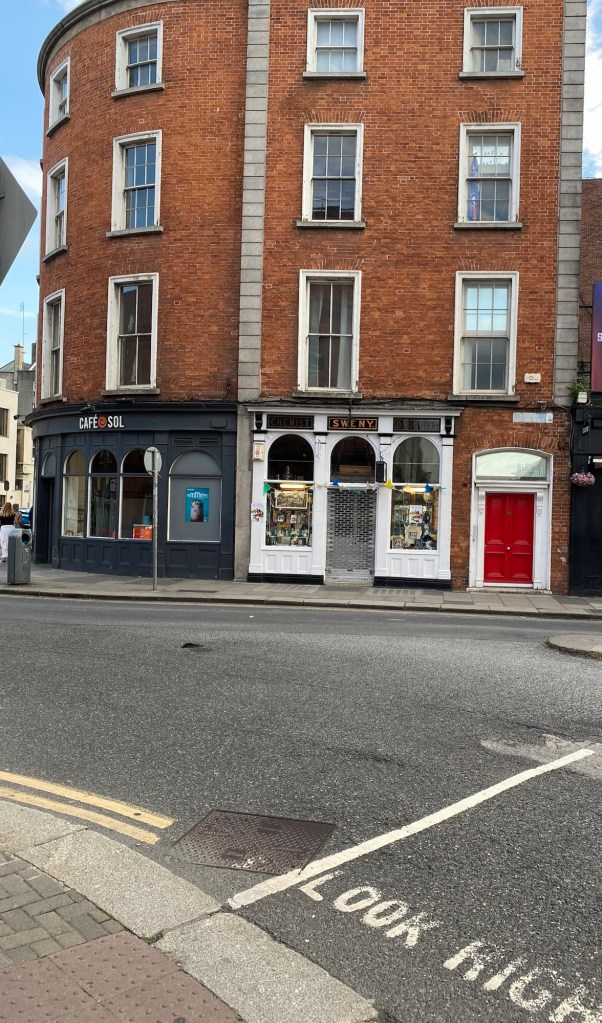
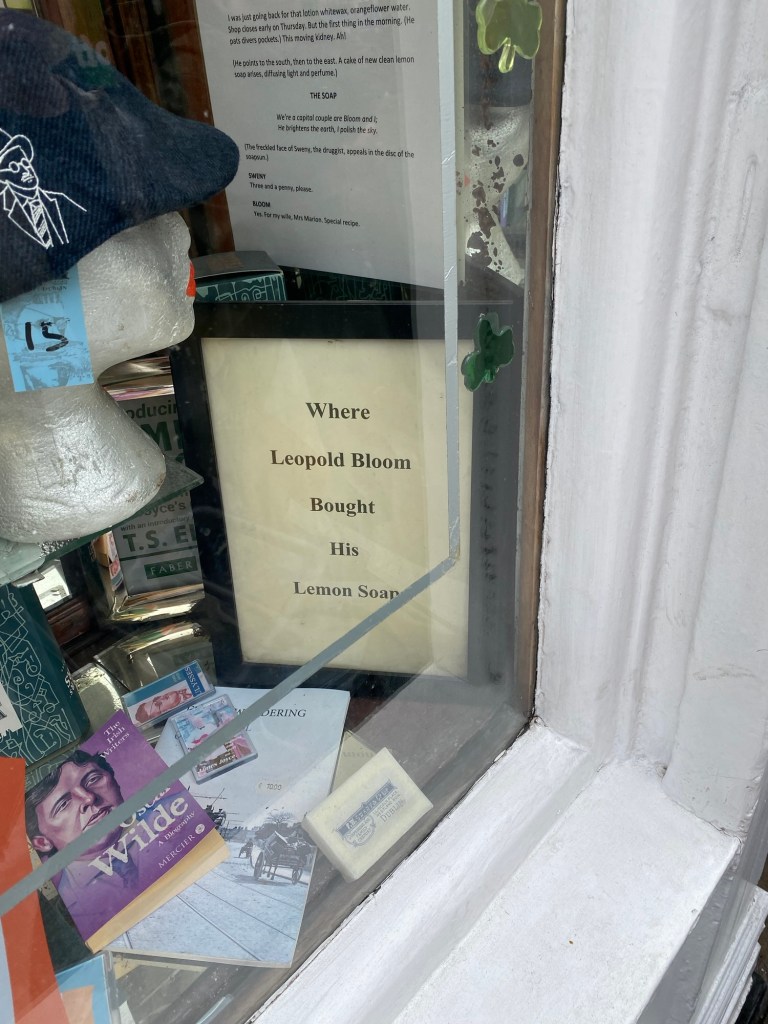
Better get that lotion made up. Where is this? Ah yes, the last time. Sweny’s in Lincoln place. Chemists rarely move. Their green and gold beaconjars too heavy to stir.
And Davy Byrne’s for lunch:

He entered Davy Byrne’s. Moral pub. He doesn’t chat. Stands a drink now
and then. But in leapyear once in four. Cashed a cheque for me once.
The spot on Westland Row where Bloom is prevented by a passing tram from ogling a woman:
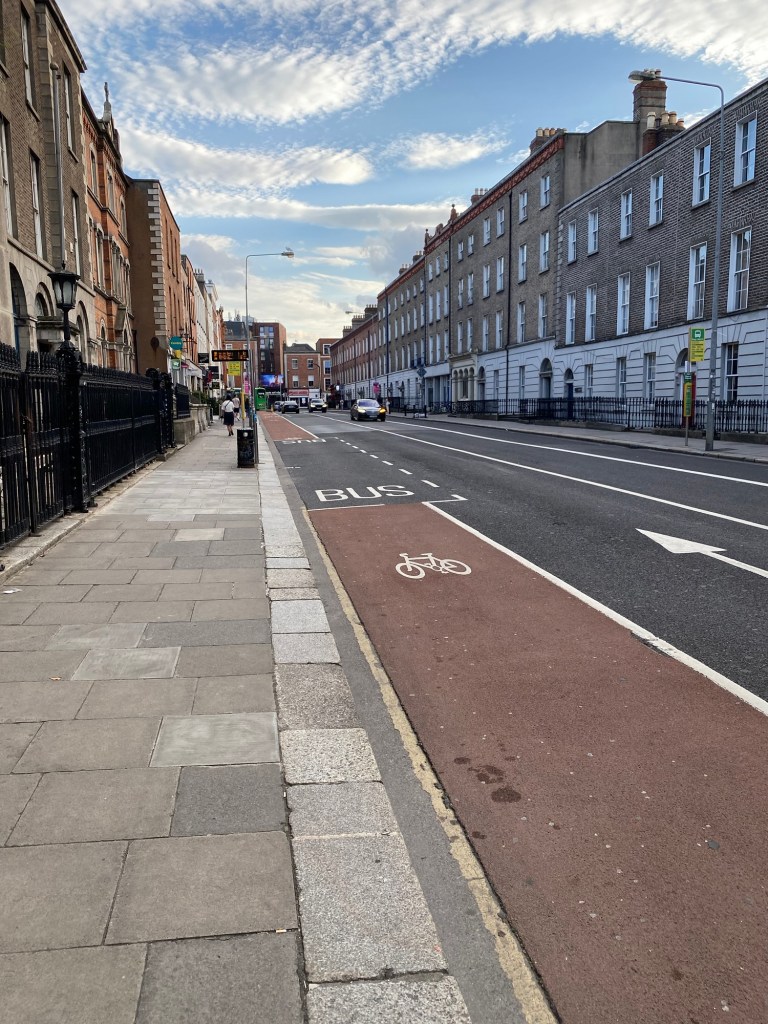
He moved a little to the side of M’Coy’s talking head. Getting up in a
minute.[…]
Watch! Watch! Silk flash rich stockings white. Watch!
A heavy tramcar honking its gong slewed between.
Lost it. Curse your noisy pugnose.
The maternity hospital on Holles Street, where most of Ulysses 14 takes place:
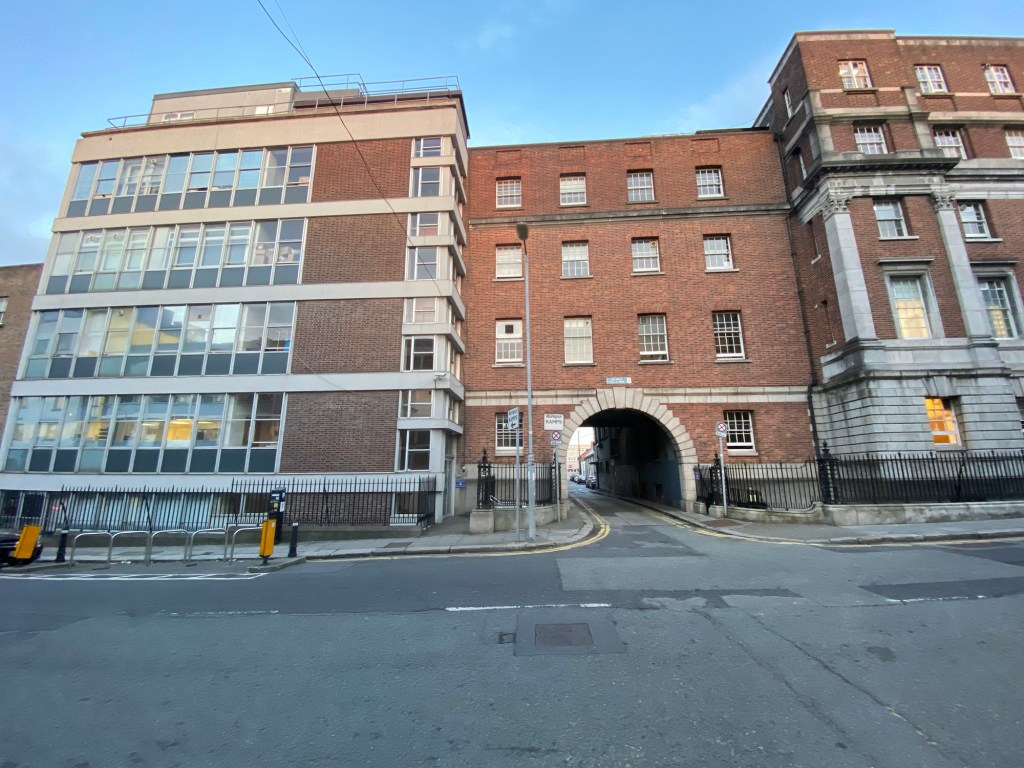
Deshil Holles Eamus. Deshil Holles Eamus. Deshil Holles Eamus.
Send us bright one, light one, Horhorn, quickening and wombfruit. Send
us bright one, light one, Horhorn, quickening and wombfruit. Send us
bright one, light one, Horhorn, quickening and wombfruit.Hoopsa boyaboy hoopsa! Hoopsa boyaboy hoopsa! Hoopsa boyaboy hoopsa!
We also took a day trip to Howth Head, which we learned is pronounced by the locals to rhyme with “both.” I had been pronouncing it all these years as if I was saying “house” with a severe lisp. I’m obstinate enough that I will probably keep pronouncing it the “wrong” way.
We saw Howth Castle, where the Prankquean comes to call on Jarl van Hoother:

Jarl van Hoother had his burnt head high up in his lamphouse, laying cold hands on himself. And his two little jiminies, cousins of ourn, Tristopher and Hilary, were kickaheeling their dummy on the oil cloth flure of his homerigh, castle and earthenhouse. And, be dermot, who come to the keep of his inn only the niece-of-his-inlaw, the prankquean. And the prankquean pulled a rosy one and made her wit foreninst the dour. And she lit up and fireland was ablaze. And spoke she to the dour in her petty perusienne: Mark the Wans, why do I am alook alike a poss of porterpease? And that was how the skirtmisshes began.
We read the ending of Ulysses on Howth Head, where Molly remembers Leopold proposing to her.


tomorrow the sun shines for you he said the day we were lying among the rhododendrons on Howth head in the grey tweed suit and his straw hat the day I got him to propose to me yes first I gave him the bit of seedcake out of my mouth and it was leapyear like now yes 16 years ago my God after that long kiss I near lost my breath yes he said I was a flower of the mountain yes so we are flowers all a womans body yes that was one true thing he said in his life and the sun shines for you today yes that was why I liked him because I saw he understood or felt what a woman is and I knew I could always get round him and I gave him all the pleasure I could leading him on till he asked me to say yes and I wouldnt answer first only looked out over the sea and the sky I was thinking of so many things he didnt know of Mulvey and Mr Stanhope and Hester and father and old captain Groves and the sailors playing all birds fly and I say stoop and washing up dishes they called it on the pier and the sentry in front of the governors house with the thing round his white helmet poor devil half roasted and the Spanish girls laughing in their shawls and their tall combs and the auctions in the morning the Greeks and the jews and the Arabs and the devil knows who else from all the ends of Europe and Duke street and the fowl market all clucking outside Larby Sharons and the poor donkeys slipping half asleep and the vague fellows in the cloaks asleep in the shade on the steps and the big wheels of the carts of the bulls and the old castle thousands of years old yes and those handsome Moors all in white and turbans like kings asking you to sit down in their little bit of a shop and Ronda with the old windows of the posadas 2 glancing eyes a lattice hid for her lover to kiss the iron and the wineshops half open at night and the castanets and the night we missed the boat at Algeciras the watchman going about serene with his lamp and O that awful deepdown torrent O and the sea the sea crimson sometimes like fire and the glorious sunsets and the figtrees in the Alameda gardens yes and all the queer little streets and the pink and blue and yellow houses and the rosegardens and the jessamine and geraniums and cactuses and Gibraltar as a girl where I was a Flower of the mountain yes when I put the rose in my hair like the Andalusian girls used or shall I wear a red yes and how he kissed me under the Moorish wall and I thought well as well him as another and then I asked him with my eyes to ask again yes and then he asked me would I yes to say yes my mountain flower and first I put my arms around him yes and drew him down to me so he could feel my breasts all perfume yes and his heart was going like mad and yes I said yes I will Yes.
After reading the passage, I proposed to my editor. I am happy to report that she said “yes I will Yes.”
Here’s to future trips to Dublin!
 The Suspended Sentence